Introduction

In today’s competitive business landscape, effective sales training has become a critical factor in determining organizational success. Among the various methodologies available, role-playing in sales training has emerged as a powerful tool that bridges the gap between theoretical knowledge and practical application. This immersive approach allows sales professionals to practice their skills in a controlled environment before facing real customers. According to research by Corporate Visions, companies that incorporate role-playing in their sales training programs see a 20% higher achievement of quota compared to those who don’t. This article delves into the transformative role of role-playing in sales training, examining how this technique prepares sales teams for success in the field.

The Psychology Behind Role-Playing in Sales Training

Role-playing taps into fundamental aspects of human learning psychology. By simulating real-world scenarios, sales professionals can experience the emotional and intellectual challenges they’ll face with actual customers. This form of experiential learning creates stronger neural pathways than passive learning methods. A study published in the Journal of Applied Psychology found that information retention rates increase by 75% when learners actively practice through role-playing compared to traditional lecture-based training. The brain processes role-playing experiences as genuine interactions, triggering the same cognitive and emotional responses that occur during actual sales conversations.

The power of role-playing lies in its ability to create a safe space for failure. Sales professionals can experiment with different approaches, make mistakes, and receive immediate feedback without the risk of losing real customers or damaging the company’s reputation. This psychological safety enables deeper learning and greater willingness to step outside comfort zones.

Building Confidence Through Structured Practice

One of the most significant benefits of role-playing in sales training is the confidence it builds in sales teams. Research by Salesforce indicates that sales representatives who regularly participate in role-playing exercises report 35% higher self-confidence levels when approaching complex sales situations. This confidence translates directly to performance, as customers quickly sense hesitation or uncertainty in sales interactions.

Role-playing scenarios should gradually increase in complexity, allowing sales professionals to build competence progressively. Beginning with simple product demonstrations and advancing to handling difficult objections or negotiating with tough customers provides a structured pathway to mastery. Sales managers can customize role-playing scenarios to address specific challenges their teams face, whether it’s explaining technical products, overcoming price objections, or navigating complex buying committees.

Creating Authentic Role-Playing Scenarios

The effectiveness of role-playing in sales training depends largely on the authenticity of the scenarios. Generic situations yield generic results, while carefully crafted scenarios based on real customer interactions drive meaningful improvements. According to research by CSO Insights, organizations that create role-playing scenarios based on actual customer data see 17% higher win rates than those using hypothetical situations.

To create authentic role-playing scenarios, sales trainers should:

  1. Incorporate actual customer language and objections from recorded calls or feedback
  2. Simulate the specific industry challenges your customers face
  3. Include realistic time constraints that sales representatives encounter
  4. Introduce unexpected obstacles that mimic real-world sales situations

When role-playing mirrors the complexity and unpredictability of genuine sales interactions, sales professionals develop adaptability—a crucial skill in today’s rapidly changing market conditions.

The Role of Feedback in Effective Role-Playing

Role-playing without structured feedback is merely practice without purpose. The feedback loop transforms role-playing from a simple exercise into a powerful development tool. A comprehensive study by Richardson Sales Performance found that sales teams receiving detailed feedback after role-playing exercises improved their performance metrics by 43% compared to those who received minimal or no feedback.

Effective feedback in role-playing contexts should balance positive reinforcement with constructive criticism. Sales managers should highlight what went well while providing specific guidance on areas for improvement. Video recording role-playing sessions allows participants to see themselves in action, often revealing behaviors or patterns they weren’t aware of. Peer feedback adds another valuable dimension, as fellow sales professionals often notice different aspects of the interaction than managers.

Technology’s Impact on Role-Playing in Sales Training

The digital transformation has revolutionized how organizations implement role-playing in sales training. Virtual role-playing platforms now allow geographically dispersed teams to practice together without travel costs. According to Training Industry research, companies using digital role-playing tools report a 28% reduction in training costs while maintaining or improving effectiveness.

Advanced technologies like artificial intelligence are further enhancing role-playing experiences. AI-powered role-playing partners can simulate different customer personalities, respond to salesperson statements in realistic ways, and provide instant analytics on performance. These technologies enable more frequent practice opportunities and create a consistent training experience across the organization.

Measuring the ROI of Role-Playing in Sales Training

Like any training initiative, role-playing must demonstrate tangible returns to justify its continued use. Fortunately, the evidence strongly supports its value. A study by the Sales Management Association found that companies with regular role-playing as part of their sales training achieved 12% higher revenue growth compared to those without structured practice programs.

To measure role-playing’s effectiveness, organizations should track key performance indicators before and after implementation. These might include conversion rates, deal cycle length, average deal size, and customer satisfaction scores. Qualitative feedback from sales professionals about their confidence and preparedness provides additional insight into role-playing’s impact.

Conclusion

The role of role-playing in sales training extends far beyond simple practice exercises. When implemented strategically, role-playing creates more confident, adaptable, and effective sales professionals who can navigate today’s complex selling environments. By combining authentic scenarios, structured feedback, and emerging technologies, organizations can maximize the impact of role-playing on sales performance.

As markets continue to evolve and buyer expectations increase, the organizations that commit to experiential learning through role-playing will maintain a competitive edge. Sales professionals trained through immersive role-playing don’t just understand sales theory—they embody the skills, behaviors, and mindsets needed for success in real-world selling situations. For any sales organization serious about performance improvement, implementing robust role-playing in sales training represents one of the highest-return investments available.

What role does role-playing play in your organization’s sales training program? We’d love to hear about your experiences and results in the comments below. If you found this article valuable, please share it with your network on social media to help others improve their sales training approaches.

FAQ

1. How often should sales teams engage in role-playing exercises? Most successful organizations implement weekly role-playing sessions for optimal skill development without overwhelming their teams.

2. Can role-playing help experienced salespeople, or is it just for newcomers? Role-playing benefits sales professionals at all experience levels by keeping skills sharp and adapting to changing market conditions.

3. What’s the ideal group size for role-playing exercises? Groups of 3-4 people work best—one acting as salesperson, one as customer, and others providing feedback.

4. Should role-plays be scripted or improvised? A blend works best—provide scenario outlines with key objectives while allowing natural conversation to develop.

5. How should managers handle reluctant participants? Start with low-pressure scenarios and provide positive reinforcement to build confidence gradually.

Read More : https://aceconsultancys.com/art-of-authentic-cold-calling/
Leave a Reply

Your email address will not be published. Required fields are marked *

Start your Project Today!

Tell us about your goals—we’ll craft a strategy that delivers real results.

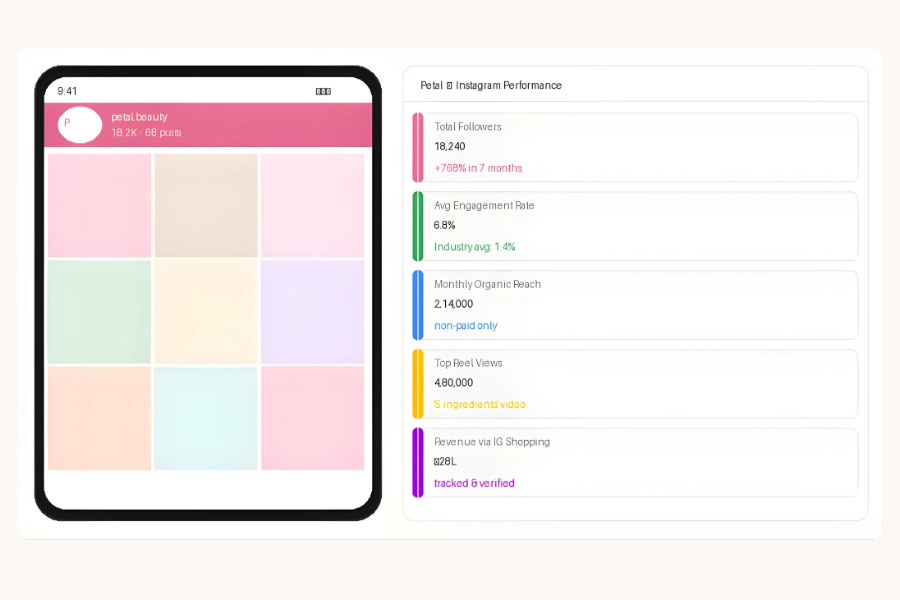
Zero to 18K: Building Petal's Community-First Instagram

From a brand nobody had discovered to a community people were recommending to their friends.

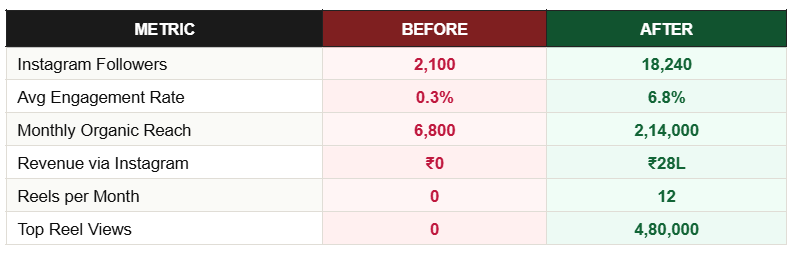
18.2K

INSTAGRAM FOLLOWERS

6.8%

AVG ENGAGEMENT RATE

₹28L

REVENUE VIA IG SHOPPING

7 Months

TIMELINE

01 · CLIENT OVERVIEW

Who We Worked With

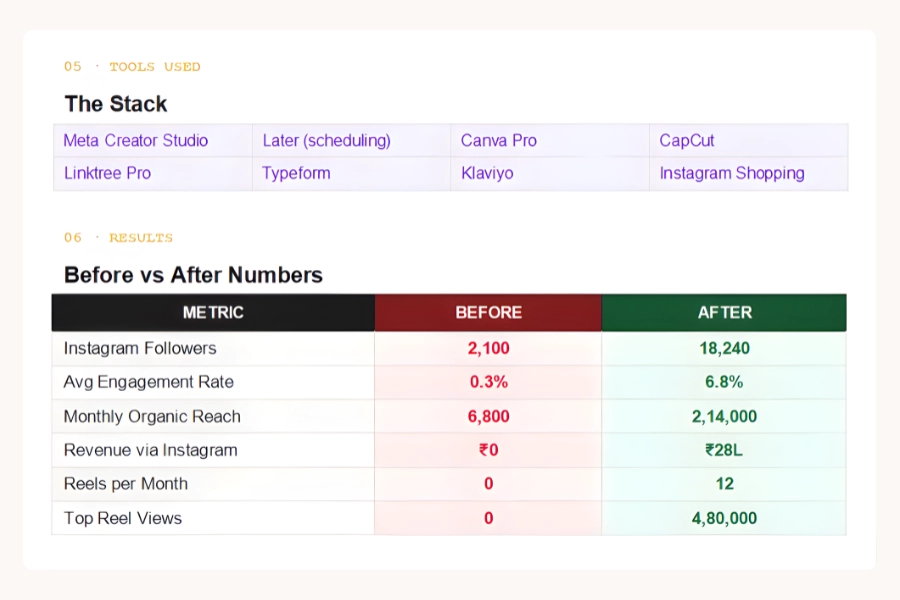
Petal is an indie beauty startup — two founders, clean ingredients positioning, genuinely excellent products, and essentially no marketing. They had 2,100 followers when we started, near-zero reach, and a founder posting inconsistently whenever she found time. The products had earned 4.8-star reviews but nobody outside their immediate circle had heard of the brand.

02 · PROBLEM STATEMENT

What Wasn't Working

The brand had no content identity, no posting system, and no strategy connecting social media to sales. What posts did exist were flat-lay product images that looked identical to every other indie beauty brand. The founder had no time, no brief, and no creative framework. There was no link-in-bio strategy and Instagram Shopping wasn't set up.

03 · STRATEGY

How We Thought About It

We repositioned Petal from 'product showcase' to 'ingredient intelligence meets real-woman narrative.' The insight: conscious beauty buyers research before they buy. They want to understand what's in the bottle, why it works, and whether the brand is run by people who actually care. Education-first content builds that trust without ever selling. We used a 3-pillar system: Ingredient Intel, Real Skin Stories, and The Formula.

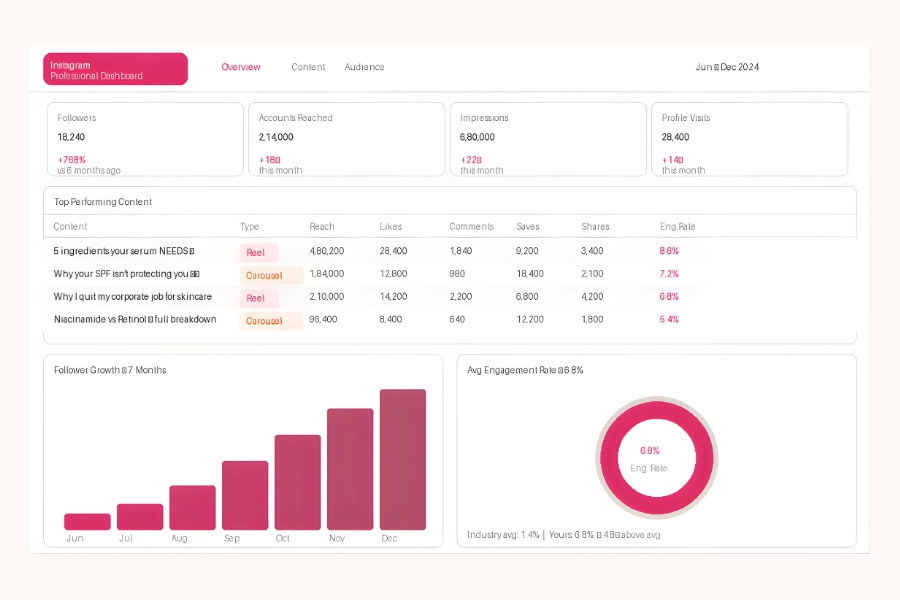
Beauty is a high-trust, high-consideration category. A follower who saves your 'Why niacinamide at 5% works' post has spent 40 seconds thinking about your product. That's 40 seconds of unprompted consideration you didn't pay for. Saves are the highest-intent action on Instagram and extend organic reach algorithmically. Teaching is the most efficient form of selling.

04 · EXECUTION

Step-by-Step Breakdown

05 · TOOLS USED

The Stack

06 · RESULTS

Before vs After Numbers

Petal Results

◈ Portfolio Design Directions (For Behance / Designer)

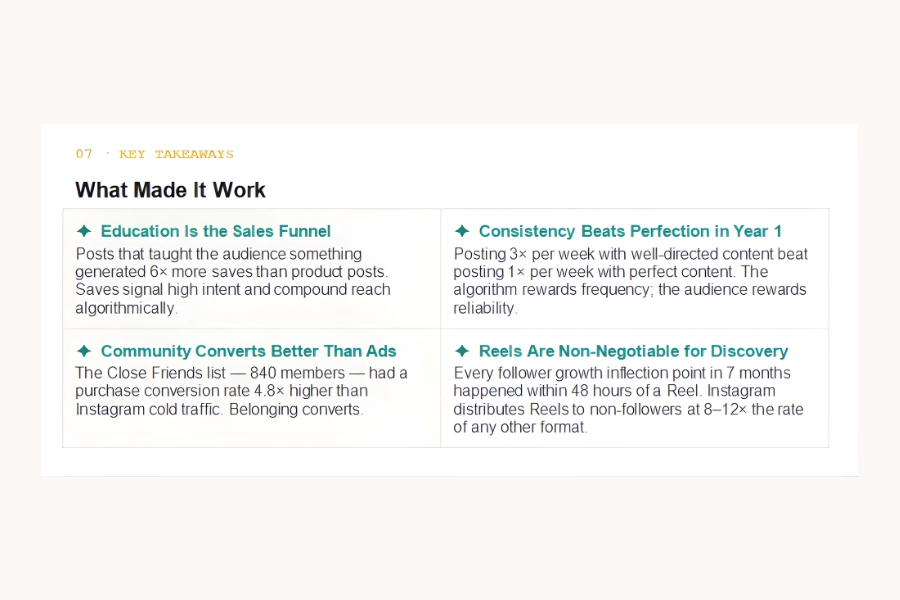
07 · KEY TAKEAWAYS

What Made It Work

Posts that taught the audience something generated 6× more saves than product posts. Saves signal high intent and compound reach algorithmically.

Posting 3× per week with well-directed content beat posting 1× per week with perfect content. The algorithm rewards frequency; the audience rewards reliability.

The Close Friends list — 840 members — had a purchase conversion rate 4.8× higher than Instagram cold traffic. Belonging converts.

Every follower growth inflection point in 7 months happened within 48 hours of a Reel. Instagram distributes Reels to non-followers at 8–12× the rate of any other format.

Screenshots

Want Results Like These?

Want to build a social media presence that earns trust, builds community, and converts?

The ₹1.8Cr Funnel Audit: How Forge Stopped Leaking Revenue

The traffic was never the problem. The funnel was the problem — and it was haemorrhaging at every single stage.

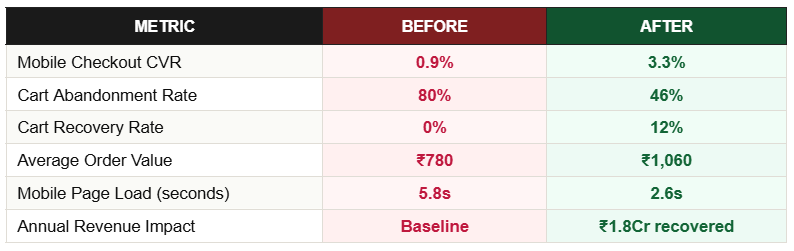
₹1.8Cr

ANNUAL REVENUE RECOVERED

+280%

CHECKOUT CONVERSION

−42%

CART ABANDONMENT

6 Weeks

TIMELINE

01 · CLIENT OVERVIEW

Who We Worked With

Forge is a funded D2C nutrition brand — protein supplements, health snacks, electrolyte drinks — spending ₹5Cr/month on paid acquisition. Strong brand awareness, high repeat purchase rate, but conversion benchmarks consistently 35–40% below category averages. The CEO knew there was leakage — just not where.

02 · PROBLEM STATEMENT

What Wasn't Working

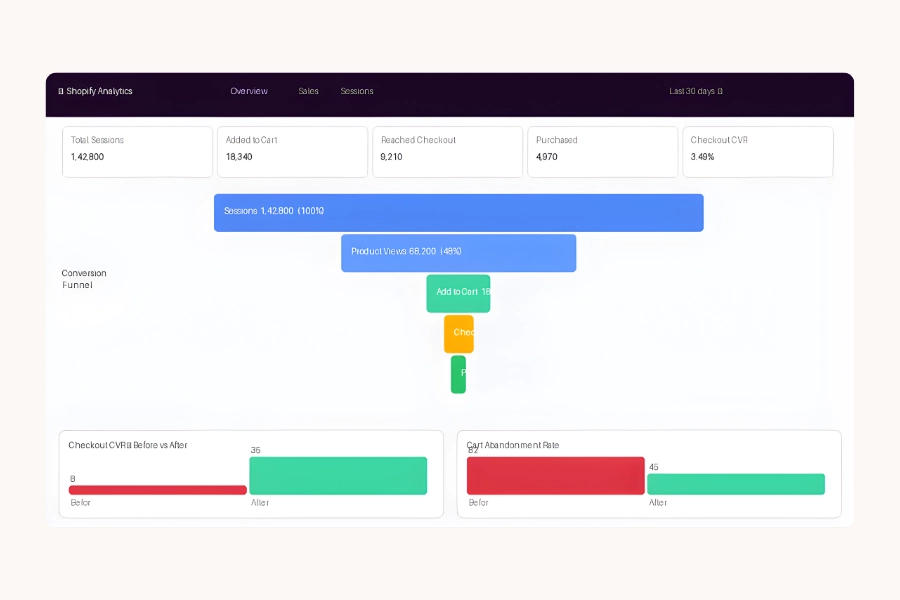
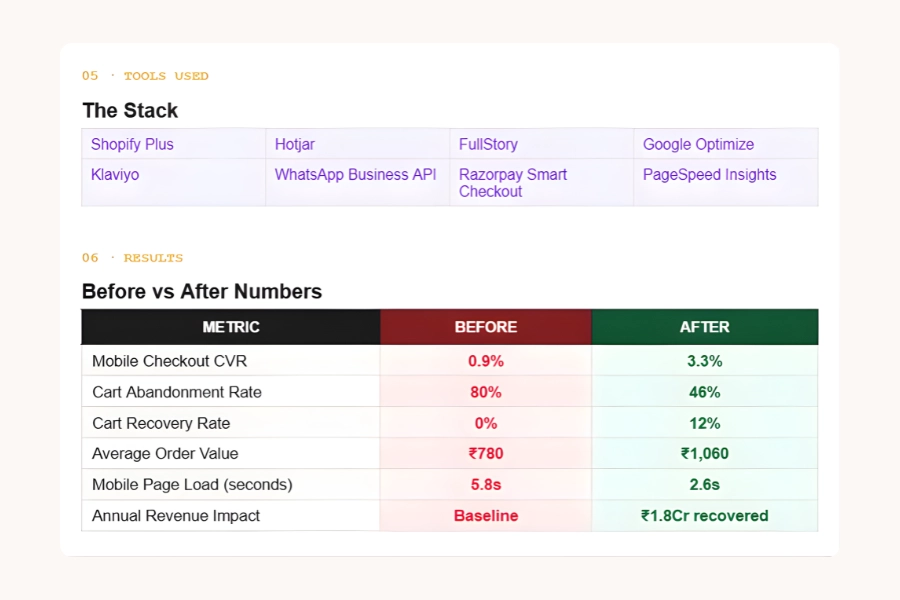
A ₹5Cr/month traffic budget was feeding a funnel that converted at 0.9% on mobile — against an industry average of 2.4%. The mobile checkout had 11 form fields. There was no cart recovery sequence. Product pages were beautiful but led with ingredient lists rather than outcomes. The brand had never run a structured CRO audit.

03 · STRATEGY

How We Thought About It

We ran a complete CRO audit before touching a single element: heatmaps to find where attention was lost, session recordings to find where users hesitated, and funnel analytics to quantify drop-off at each stage. Only after building the full picture did we prioritise fixes by impact-to-effort ratio. High-impact, low-effort changes first. A/B tests on every significant change before full rollout.

At ₹5Cr monthly ad spend, even a 0.5% improvement in checkout conversion rate generates significant incremental monthly revenue — with no additional acquisition cost. Funnel optimisation at scale has the highest ROI of any marketing activity. The traffic is already paid for.

04 · EXECUTION

Step-by-Step Breakdown

05 · TOOLS USED

The Stack

06 · RESULTS

Before vs After Numbers

Forge Results

◈ Portfolio Design Directions (For Behance / Designer)

07 · KEY TAKEAWAYS

What Made It Work

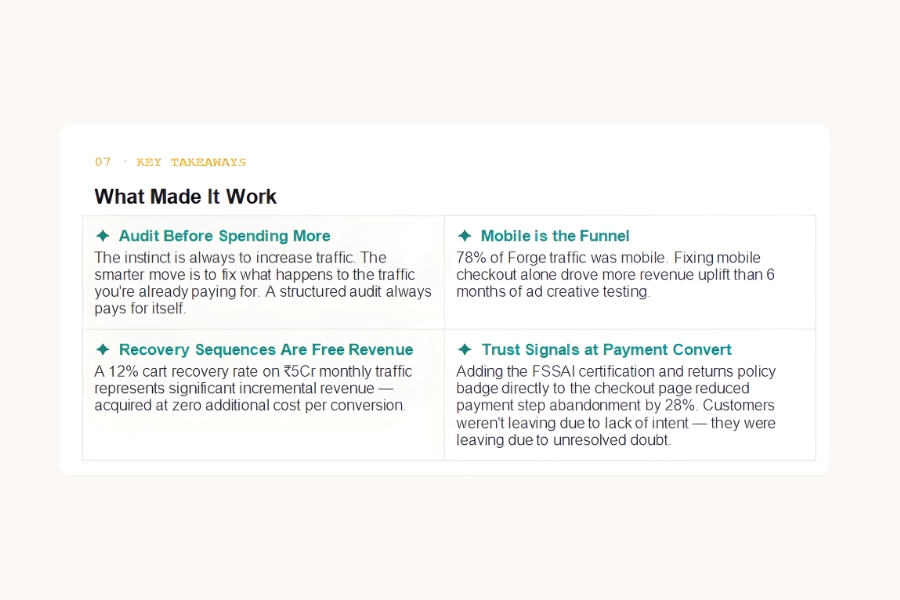
The instinct is always to increase traffic. The smarter move is to fix what happens to the traffic you're already paying for. A structured audit always pays for itself.

78% of Forge traffic was mobile. Fixing mobile checkout alone drove more revenue uplift than 6 months of ad creative testing.

A 12% cart recovery rate on ₹5Cr monthly traffic represents significant incremental revenue — acquired at zero additional cost per conversion.

Adding the FSSAI certification and returns policy badge directly to the checkout page reduced payment step abandonment by 28%. Customers weren't leaving due to lack of intent — they were leaving due to unresolved doubt.

Screenshots

Want Results Like These?

Want us to audit your funnel and find the revenue that's already in your traffic?

The B2B Lead Machine: 48 Qualified Leads/Month for Velo

We stopped paying for traffic from students. We started paying for pipeline from decision-makers.

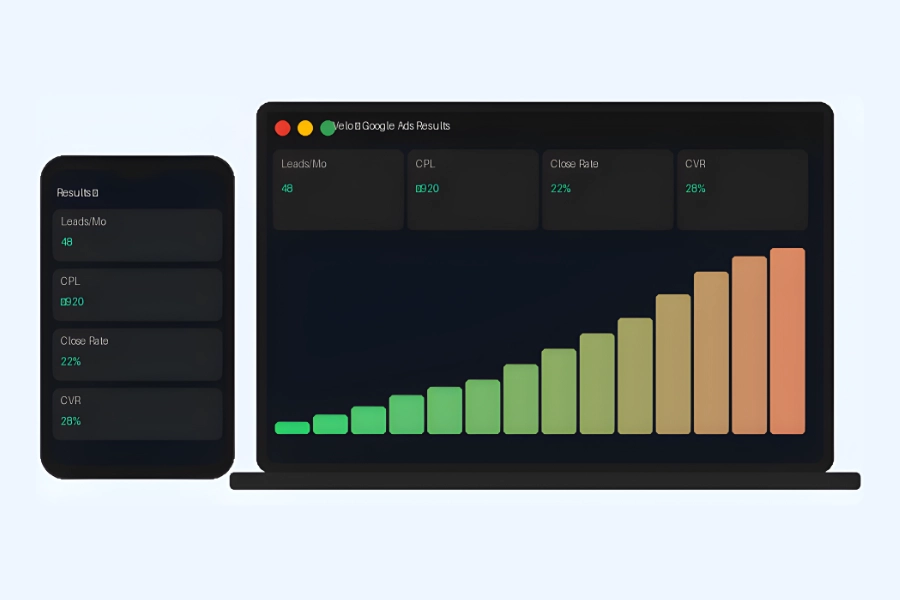
48

QUALIFIED LEADS / MONTH

₹920

COST PER LEAD

4x

LEAD VOLUME GROWTH

60 Days

TIMELINE

01 · CLIENT OVERVIEW

Who We Worked With

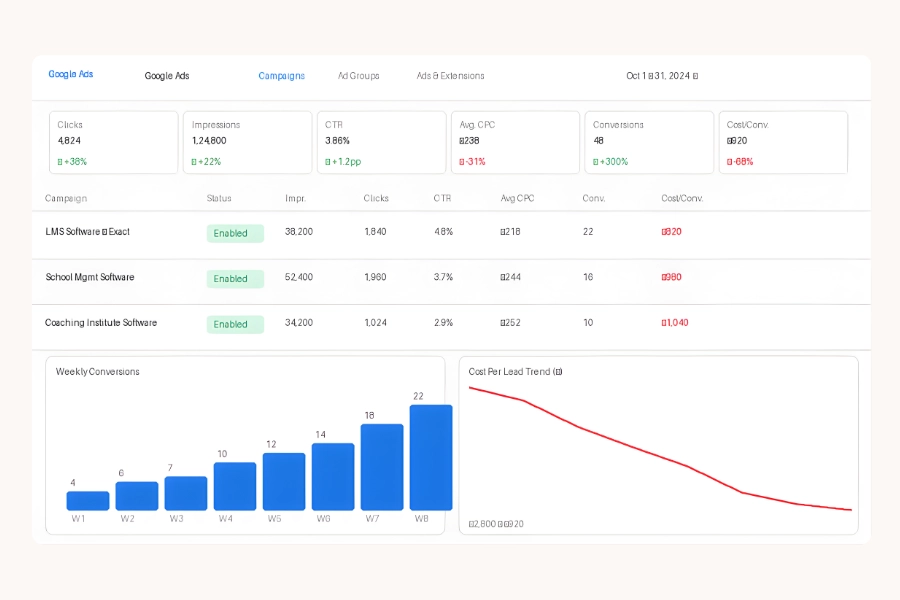
Velo is a B2B EdTech SaaS providing LMS and school management software to K–12 schools and coaching institutes across India. Series-A stage with a 4-person sales team. They were generating MRR but leaking heavily on acquisition — each qualified lead was costing far more than it should, and most leads weren't qualified at all.

02 · PROBLEM STATEMENT

What Wasn't Working

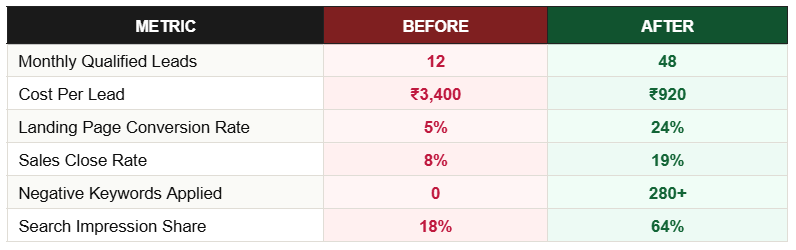
The Google Ads account was running broad-match keyword campaigns that were attracting students searching for study materials and tutoring — completely different from Velo's ICP of institute owners and school principals. Their landing page had no form above the fold, a generic 'Learn More' CTA, and a 5% conversion rate. Of 12 monthly leads, fewer than 4 would convert to demos.

03 · STRATEGY

How We Thought About It

Two parallel workstreams: account restructure and landing page rebuild. The core insight was that B2B buyers in EdTech need to see specific, outcome-led claims ('manage 500 students without a single spreadsheet') rather than feature lists. We restructured the campaigns to use exact and phrase match only, built ICP-specific landing pages per campaign, and connected CRM-qualified leads back to Google Smart Bidding as conversion signals.

In B2B Google Ads, message-to-market match is the primary lever. An institute owner looking for LMS software will click a generic ad — but they convert only when the landing page speaks exactly to their pain (manual fee collection, parent communication, attendance tracking). We built dedicated pages for each keyword theme with relevant outcomes front and centre.

04 · EXECUTION

Step-by-Step Breakdown

05 · TOOLS USED

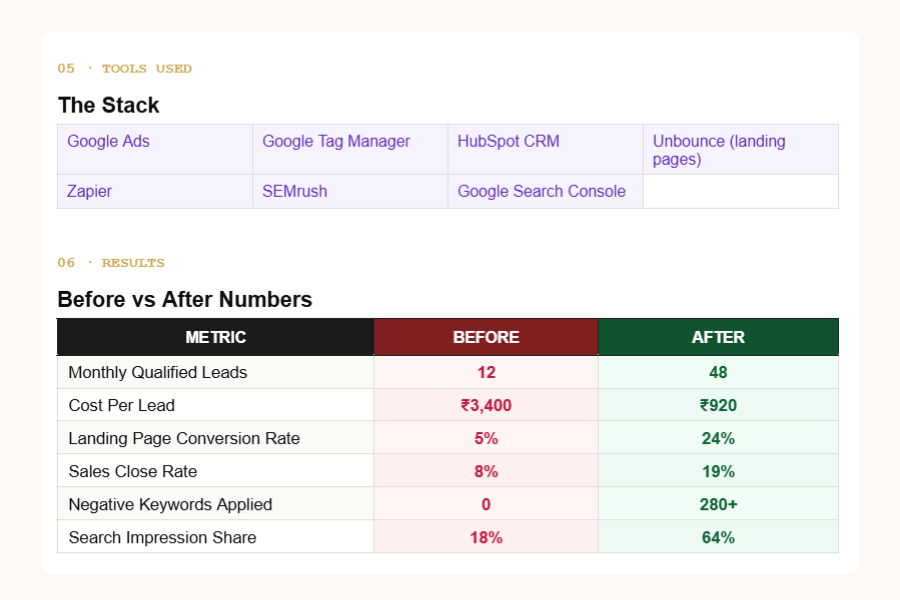
The Stack

06 · RESULTS

Before vs After Numbers

Velo Results

◈ Portfolio Design Directions (For Behance / Designer)

07 · KEY TAKEAWAYS

What Made It Work

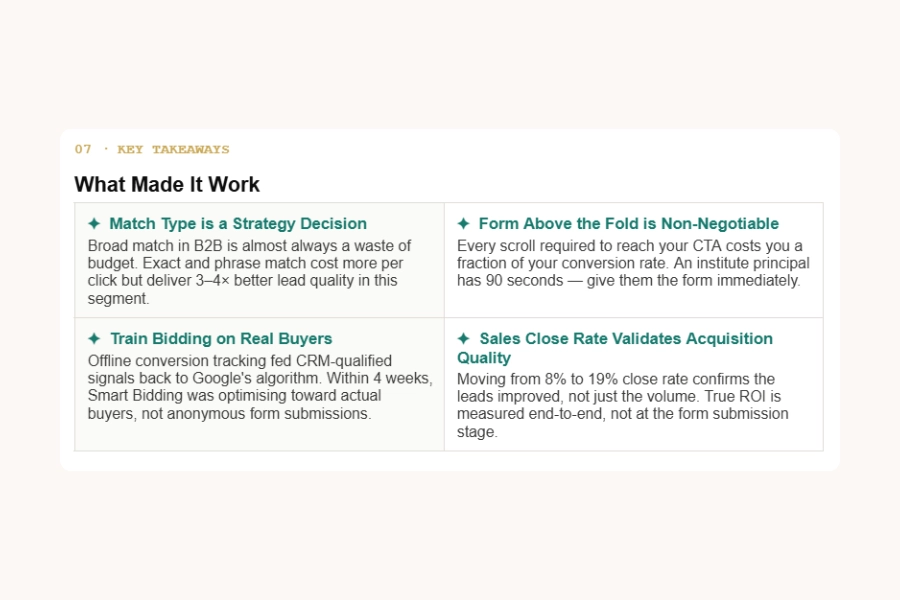
Broad match in B2B is almost always a waste of budget. Exact and phrase match cost more per click but deliver 3–4× better lead quality in this segment.

Every scroll required to reach your CTA costs you a fraction of your conversion rate. An institute principal has 90 seconds — give them the form immediately.

Offline conversion tracking fed CRM-qualified signals back to Google's algorithm. Within 4 weeks, Smart Bidding was optimising toward actual buyers, not anonymous form submissions.

Moving from 8% to 19% close rate confirms the leads improved, not just the volume. True ROI is measured end-to-end, not at the form submission stage.

Screenshots

Want Results Like These?

Want us to rebuild your Google Ads account around qualified pipeline — not just traffic?

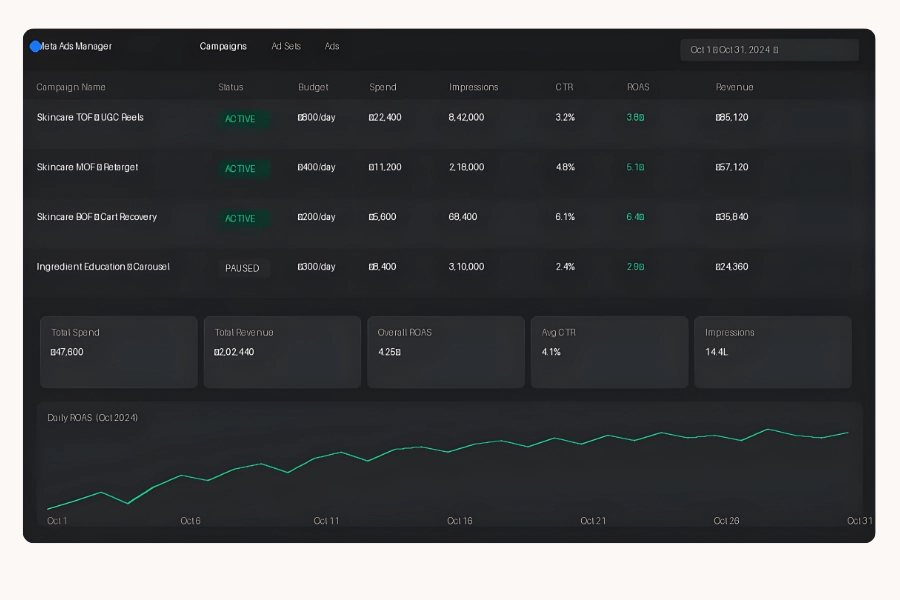
From Scroll to Sale: Rebuilding Lumis's Meta Engine

We stopped burning budget and started building a brand that actually pays for itself.

3.8x

ROAS

₹58L

PEAK REV / MONTH

−48%

COST PER ACQUISITION

11 Wks

TIMELINE

01 · CLIENT OVERVIEW

Who We Worked With

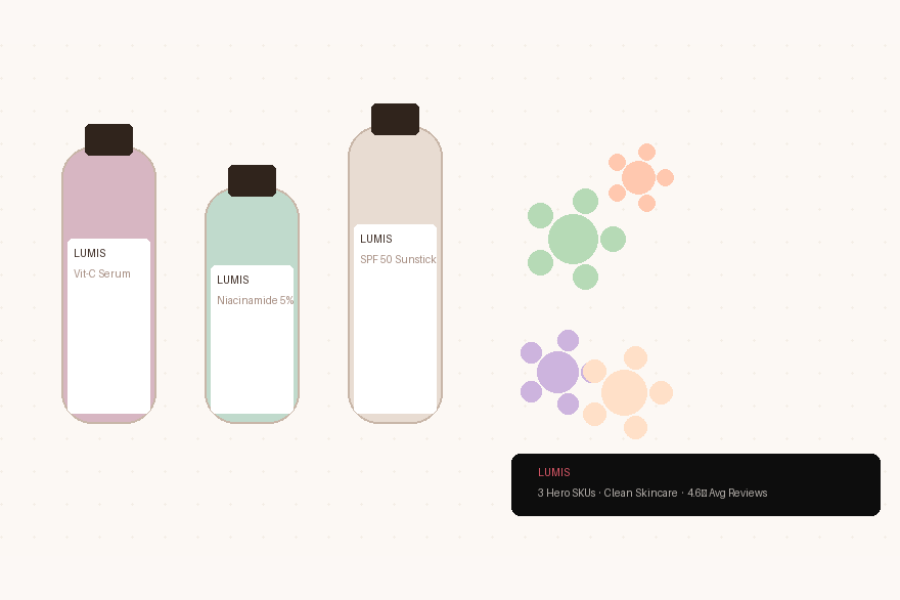
Nykora is a bootstrapped D2C skincare brand with three hero SKUs — a vitamin C serum, a niacinamide moisturiser, and an SPF sunstick — operating in the mass-premium segment. At two years old, they had strong product-market fit evidenced by 4.6-star reviews across 1,200+ orders. But they couldn't grow profitably past ₹22L/month despite steadily increasing Meta ad spend.

02 · PROBLEM STATEMENT

What Wasn't Working

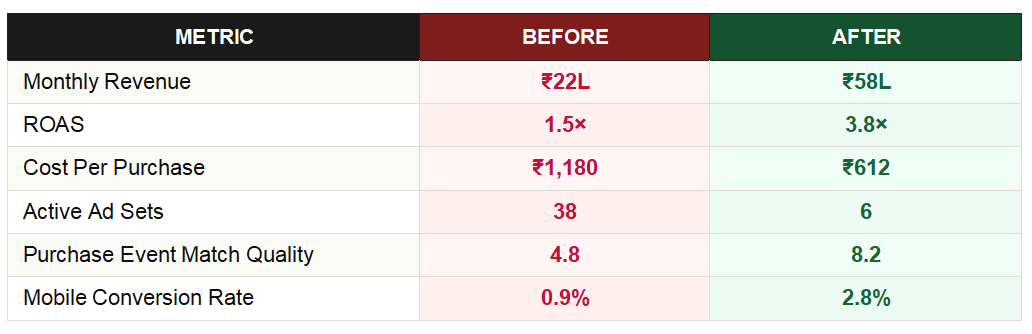
Nykora's Meta account was structurally broken before it was creatively weak. 38 ad sets ran simultaneously with no campaign organisation. Their Pixel had a purchase event misconfiguration — 40% of actual purchases went untracked. ROAS averaged 1.4–1.6×, below their breakeven of 2.2×. Every budget increase made losses worse, not better.

03 · STRATEGY

How We Thought About It

The diagnosis was structural before creative. Nykora had no working attribution, no campaign hierarchy, and no testing system. Our approach: restore tracking integrity first, then consolidate the account architecture so the algorithm receives clean signal, then build a UGC creative testing system. Scale only after all three foundations were in place.

The diagnosis was structural before creative. Nykora had no working attribution, no campaign hierarchy, and no testing system. Our approach: restore tracking integrity first, then consolidate the account architecture so the algorithm receives clean signal, then build a UGC creative testing system. Scale only after all three foundations were in place.

04 · EXECUTION

Step-by-Step Breakdown

05 · TOOLS USED

The Stack

06 · RESULTS

Before vs After Numbers

Lumis Results

◈ Portfolio Design Directions (For Behance / Designer)

07 · KEY TAKEAWAYS

What Made It Work

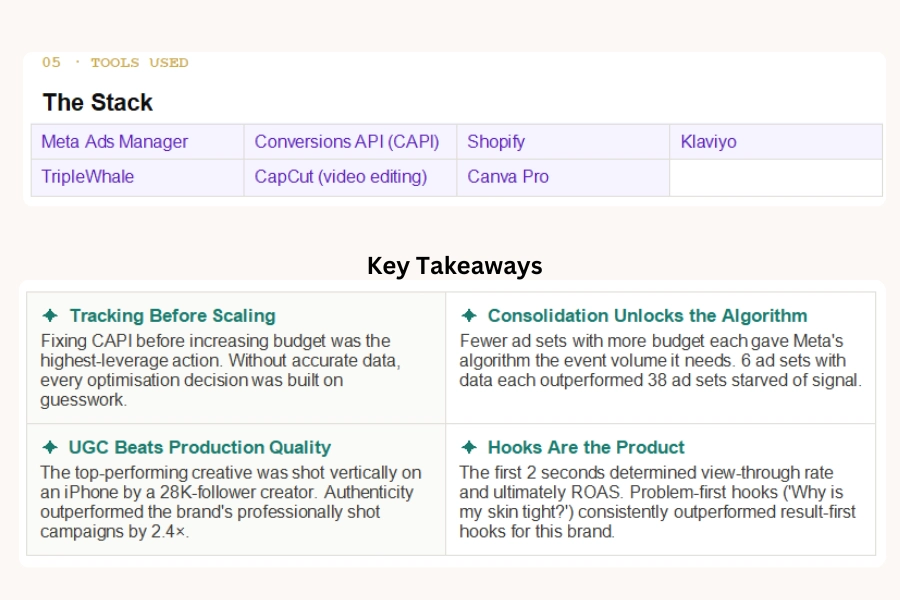
Fixing CAPI before increasing budget was the highest-leverage action. Without accurate data, every optimisation decision was built on guesswork.

Fewer ad sets with more budget each gave Meta's algorithm the event volume it needs. 6 ad sets with data each outperformed 38 ad sets starved of signal.

The top-performing creative was shot vertically on an iPhone by a 28K-follower creator. Authenticity outperformed the brand's professionally shot campaigns by 2.4×.

The first 2 seconds determined view-through rate and ultimately ROAS. Problem-first hooks ('Why is my skin tight?') consistently outperformed result-first hooks for this brand.

Screenshots

Want Results Like These?

Want us to audit your Meta account and rebuild it for profitable scale?