Introduction

In today’s competitive business landscape, sales call etiquette can make or break your chances of closing a deal. According to a study by Salesforce, 85% of customers report that the experience a company provides is as important as its products or services when making purchasing decisions. Mastering sales call etiquette isn’t just about being polite—it’s about strategic communication that builds trust, demonstrates value, and moves prospects through your sales funnel effectively. Whether you’re a seasoned sales professional or just starting out, understanding what to say and what to avoid during sales calls can dramatically improve your conversion rates and help you build lasting customer relationships.

The Critical First 30 Seconds

The opening moments of your sales call set the tone for the entire conversation. Research from Gong.io shows that successful sales calls typically begin with a clear, concise introduction that respects the prospect’s time. Their analysis of over 2 million sales calls revealed that top-performing salespeople spend 40% less time talking about their company in the first 30 seconds than their less successful counterparts.

When making your introduction, identify yourself and your company clearly, then immediately acknowledge the value of your prospect’s time. For example: “Hi [Name], this is [Your Name] from [Company]. I know you’re busy, so I appreciate you taking my call. Is this still a good time to talk for about [specific time frame]?”

What to avoid in these crucial opening moments is equally important. Never launch into a scripted pitch without confirming the prospect has time to talk. Additionally, avoid using vague language about why you’re calling—ambiguity creates suspicion and reduces trust.

Building Rapport Without Wasting Time

Sales call etiquette demands finding the balance between building genuine rapport and respecting business boundaries. According to Harvard Business Review, salespeople who connect with prospects on a personal level are 240% more likely to move forward in the sales process. However, this doesn’t mean forcing awkward small talk.

Effective rapport-building stems from authentic curiosity about your prospect’s situation. Ask thoughtful questions about their business challenges that demonstrate you’ve done your homework. For instance: “I noticed your company recently expanded into the West Coast market. How has that transition been going?”

What to avoid here is superficial or overly personal conversation that feels insincere or invasive. Skip generic comments about the weather unless there’s something genuinely remarkable happening. Similarly, avoid discussing polarizing topics like politics or making assumptions about personal interests based on limited information.

The Art of Active Listening

Perhaps the most underrated aspect of sales call etiquette is mastering active listening. A study by Sales Hacker found that top-performing salespeople talk only 43% of the time during successful sales calls, spending the majority listening to prospects.

Active listening involves more than simply waiting for your turn to speak. It requires acknowledging what you’ve heard, asking clarifying questions, and demonstrating understanding of the prospect’s situation. Phrases like “If I understand correctly…” or “That sounds challenging, can you tell me more about…” signal that you’re genuinely engaged.

What to avoid is interrupting the prospect, finishing their sentences, or immediately countering their concerns with solutions before fully understanding the problem. These behaviors signal that you’re more interested in making your pitch than solving their problems.

Handling Objections with Grace

Every salesperson encounters objections, but sales call etiquette dictates how you respond makes all the difference. According to data from Richardson Sales Performance, 77% of successful deals involve salespeople who address objections directly rather than avoiding them or becoming defensive.

When a prospect raises an objection, acknowledge it as valid rather than dismissing it. For example: “That’s a fair concern. Many of our current clients initially had similar questions about [objection].” Then address the specific concern with evidence, case studies, or testimonials that speak directly to their worry.

What to avoid is taking objections personally or becoming argumentative. Never use phrases like “Actually, you’re wrong about that” or “You don’t understand our offering.” These defensive responses damage rapport and decrease trust. Equally important is avoiding over-promising just to overcome an objection—this creates problems later in the customer relationship.

The Strategic Close

Closing techniques require particular attention to sales call etiquette. Research from HubSpot indicates that 58% of prospects want to discuss pricing on the first call, yet many salespeople avoid this conversation. Being transparent about costs demonstrates respect for the prospect’s decision-making process.

When moving toward closing, summarize what you’ve learned about the prospect’s situation and clearly articulate how your solution addresses their specific needs. Then, propose a concrete next step: “Based on what we’ve discussed, I’d recommend scheduling a demo with our technical team next week. How does Tuesday at 2 PM work for your schedule?”

What to avoid is using high-pressure closing tactics that create discomfort. Phrases like “What would it take to get you to sign today?” or artificial urgency like “This price is only available until the end of the day” damage trust. Also avoid vague closes—always have a specific next action in mind.

Conclusion

Mastering sales call etiquette is foundational to sales success. By focusing on prospect-centric conversations, active listening, and respectful handling of objections, you can significantly improve your conversion rates while building stronger customer relationships. Remember that every interaction is an opportunity to demonstrate your company’s values and commitment to customer success. Sales call etiquette isn’t just about avoiding mistakes—it’s about creating a positive experience that makes prospects want to continue the conversation and ultimately become loyal customers.

We’d love to hear about your experiences with sales call etiquette. What techniques have worked well for you? What challenges have you faced? Please share your thoughts in the comments section below and consider sharing this article with your sales network on LinkedIn or Twitter to continue the conversation.

FAQ

How long should an ideal sales call last?

A: The ideal sales call length varies by industry, but research suggests 30-45 minutes is optimal for most B2B scenarios. Focus on quality over duration, ensuring you cover key points while respecting the prospect’s time.

Q: Is it appropriate to call prospects without scheduling first?

A: Cold calling remains effective when done respectfully. However, whenever possible, send a brief email first suggesting a call time or use LinkedIn to establish initial contact before calling.

Q: How should I handle a prospect who keeps interrupting?

A: Remain patient and listen actively. When appropriate, gently redirect with phrases like “That’s an excellent point. If I could just add…” Then return to your key message concisely.

Q: Should I follow up after a sales call that didn’t result in a sale?

A: Absolutely. Send a personalized follow-up within 24 hours thanking them for their time and providing any requested information.
Leave a Reply

Your email address will not be published. Required fields are marked *

Run on Autopilot

Tell us about your goals—we’ll craft a strategy that delivers real results.

Zero to 18K: Building Petal's Community-First Instagram

From a brand nobody had discovered to a community people were recommending to their friends.

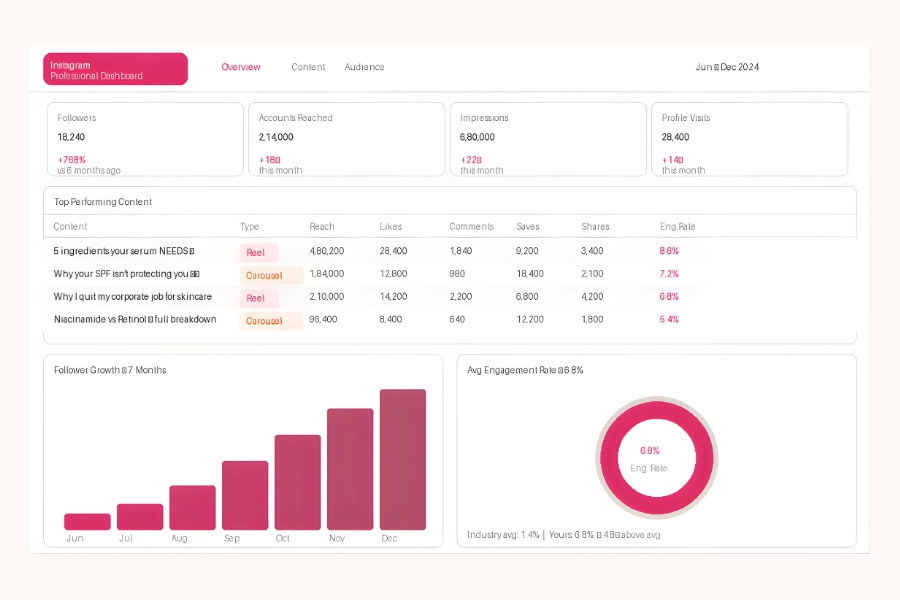
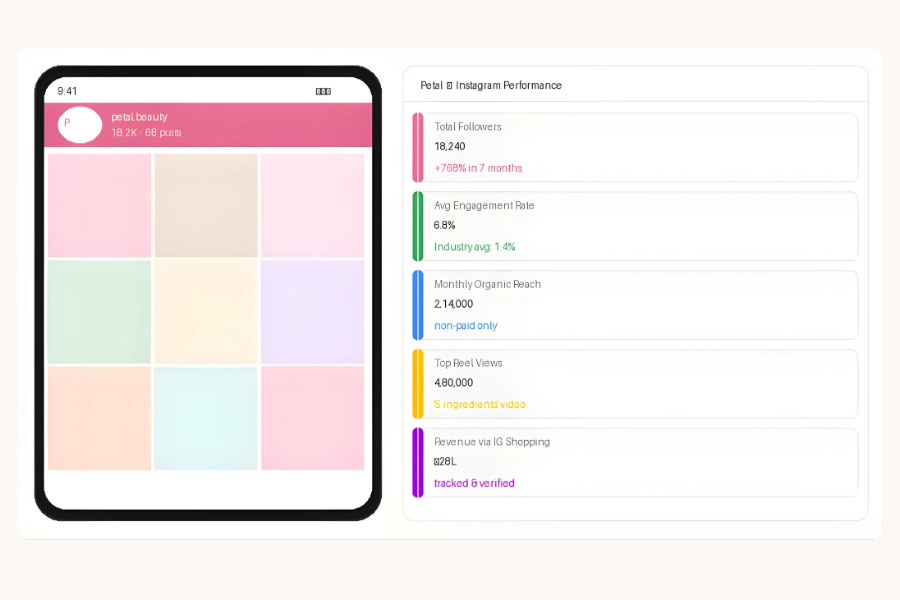
18.2K

INSTAGRAM FOLLOWERS

6.8%

AVG ENGAGEMENT RATE

₹28L

REVENUE VIA IG SHOPPING

7 Months

TIMELINE

01 · CLIENT OVERVIEW

Who We Worked With

Petal is an indie beauty startup — two founders, clean ingredients positioning, genuinely excellent products, and essentially no marketing. They had 2,100 followers when we started, near-zero reach, and a founder posting inconsistently whenever she found time. The products had earned 4.8-star reviews but nobody outside their immediate circle had heard of the brand.

02 · PROBLEM STATEMENT

What Wasn't Working

The brand had no content identity, no posting system, and no strategy connecting social media to sales. What posts did exist were flat-lay product images that looked identical to every other indie beauty brand. The founder had no time, no brief, and no creative framework. There was no link-in-bio strategy and Instagram Shopping wasn't set up.

03 · STRATEGY

How We Thought About It

We repositioned Petal from 'product showcase' to 'ingredient intelligence meets real-woman narrative.' The insight: conscious beauty buyers research before they buy. They want to understand what's in the bottle, why it works, and whether the brand is run by people who actually care. Education-first content builds that trust without ever selling. We used a 3-pillar system: Ingredient Intel, Real Skin Stories, and The Formula.

Beauty is a high-trust, high-consideration category. A follower who saves your 'Why niacinamide at 5% works' post has spent 40 seconds thinking about your product. That's 40 seconds of unprompted consideration you didn't pay for. Saves are the highest-intent action on Instagram and extend organic reach algorithmically. Teaching is the most efficient form of selling.

04 · EXECUTION

Step-by-Step Breakdown

05 · TOOLS USED

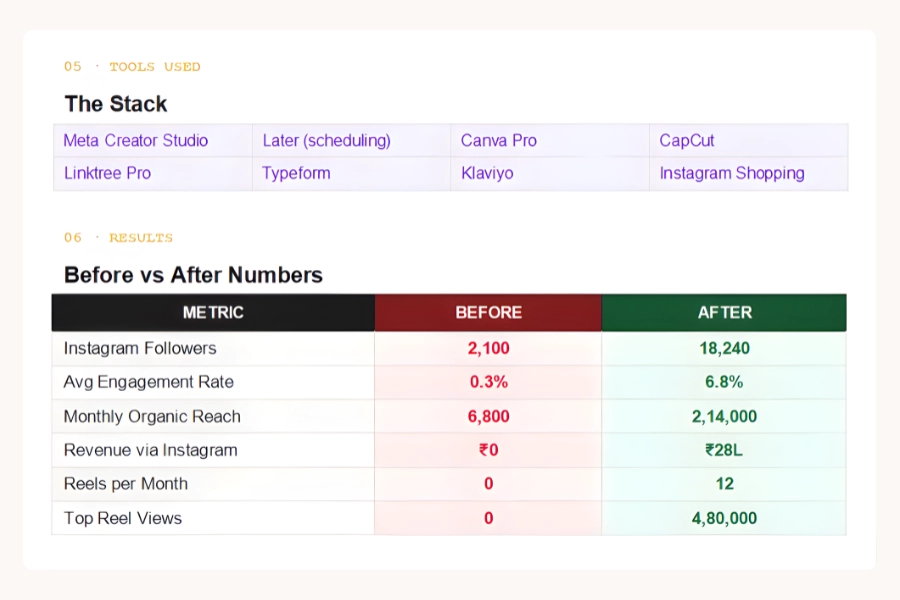
The Stack

06 · RESULTS

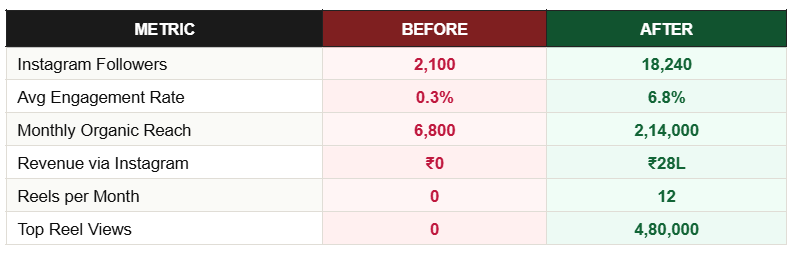
Before vs After Numbers

Petal Results

◈ Portfolio Design Directions (For Behance / Designer)

07 · KEY TAKEAWAYS

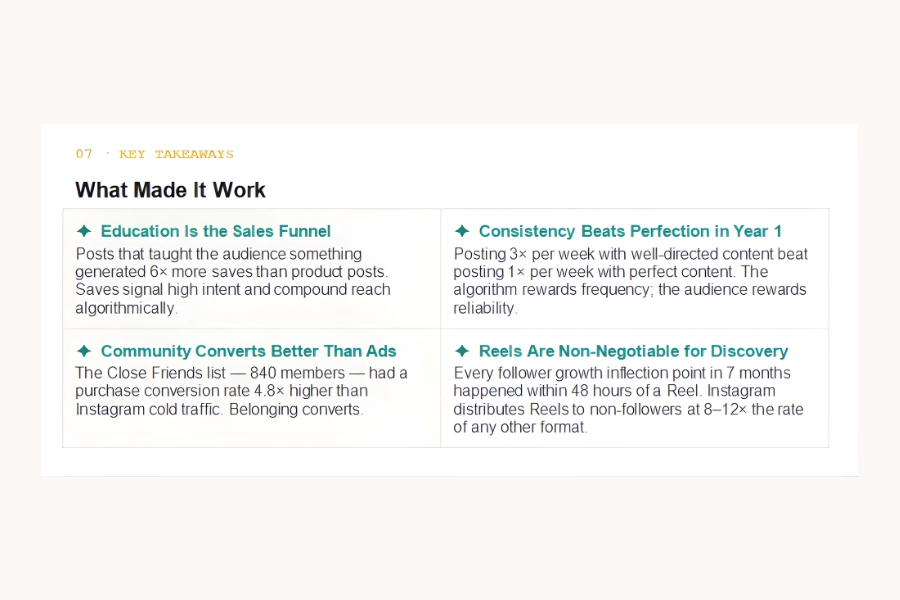
What Made It Work

Posts that taught the audience something generated 6× more saves than product posts. Saves signal high intent and compound reach algorithmically.

Posting 3× per week with well-directed content beat posting 1× per week with perfect content. The algorithm rewards frequency; the audience rewards reliability.

The Close Friends list — 840 members — had a purchase conversion rate 4.8× higher than Instagram cold traffic. Belonging converts.

Every follower growth inflection point in 7 months happened within 48 hours of a Reel. Instagram distributes Reels to non-followers at 8–12× the rate of any other format.

Screenshots

Want Results Like These?

Want to build a social media presence that earns trust, builds community, and converts?

The ₹1.8Cr Funnel Audit: How Forge Stopped Leaking Revenue

The traffic was never the problem. The funnel was the problem — and it was haemorrhaging at every single stage.

₹1.8Cr

ANNUAL REVENUE RECOVERED

+280%

CHECKOUT CONVERSION

−42%

CART ABANDONMENT

6 Weeks

TIMELINE

01 · CLIENT OVERVIEW

Who We Worked With

Forge is a funded D2C nutrition brand — protein supplements, health snacks, electrolyte drinks — spending ₹5Cr/month on paid acquisition. Strong brand awareness, high repeat purchase rate, but conversion benchmarks consistently 35–40% below category averages. The CEO knew there was leakage — just not where.

02 · PROBLEM STATEMENT

What Wasn't Working

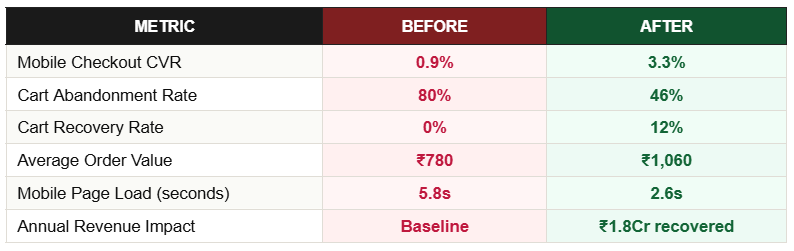
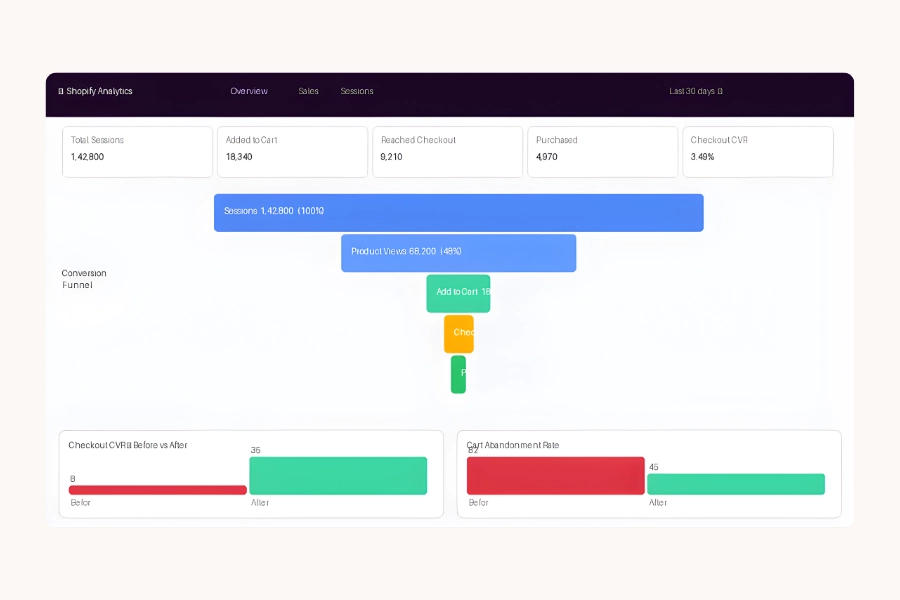
A ₹5Cr/month traffic budget was feeding a funnel that converted at 0.9% on mobile — against an industry average of 2.4%. The mobile checkout had 11 form fields. There was no cart recovery sequence. Product pages were beautiful but led with ingredient lists rather than outcomes. The brand had never run a structured CRO audit.

03 · STRATEGY

How We Thought About It

We ran a complete CRO audit before touching a single element: heatmaps to find where attention was lost, session recordings to find where users hesitated, and funnel analytics to quantify drop-off at each stage. Only after building the full picture did we prioritise fixes by impact-to-effort ratio. High-impact, low-effort changes first. A/B tests on every significant change before full rollout.

At ₹5Cr monthly ad spend, even a 0.5% improvement in checkout conversion rate generates significant incremental monthly revenue — with no additional acquisition cost. Funnel optimisation at scale has the highest ROI of any marketing activity. The traffic is already paid for.

04 · EXECUTION

Step-by-Step Breakdown

05 · TOOLS USED

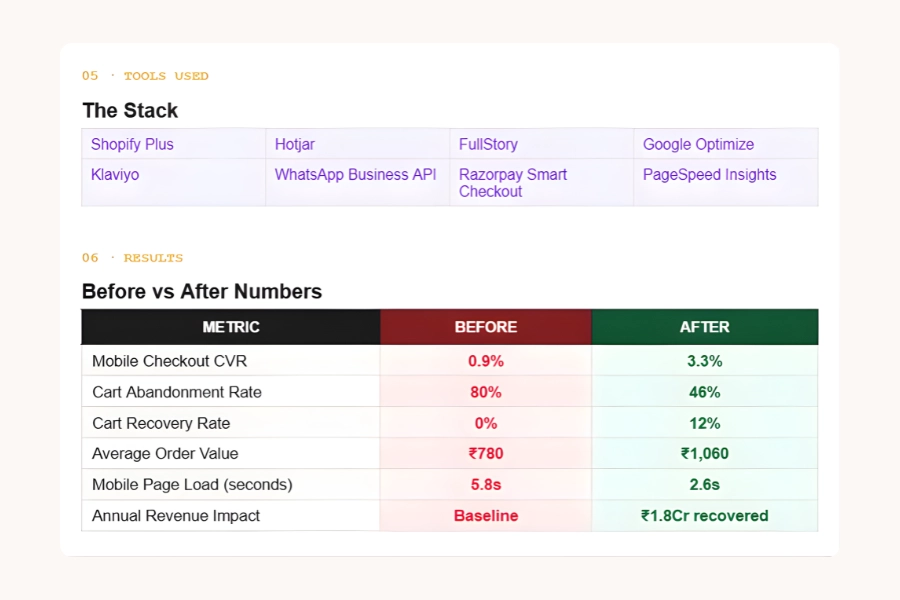
The Stack

06 · RESULTS

Before vs After Numbers

Forge Results

◈ Portfolio Design Directions (For Behance / Designer)

07 · KEY TAKEAWAYS

What Made It Work

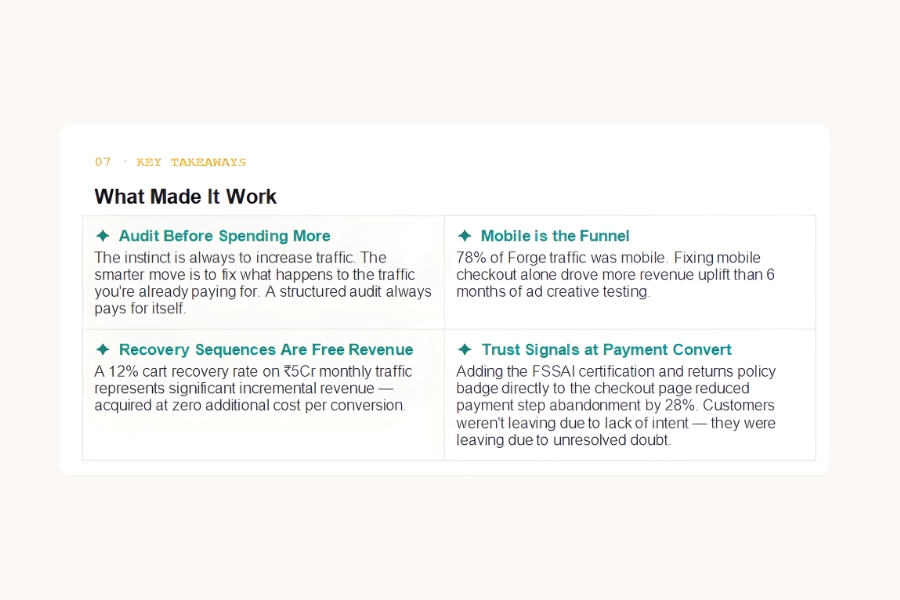
The instinct is always to increase traffic. The smarter move is to fix what happens to the traffic you're already paying for. A structured audit always pays for itself.

78% of Forge traffic was mobile. Fixing mobile checkout alone drove more revenue uplift than 6 months of ad creative testing.

A 12% cart recovery rate on ₹5Cr monthly traffic represents significant incremental revenue — acquired at zero additional cost per conversion.

Adding the FSSAI certification and returns policy badge directly to the checkout page reduced payment step abandonment by 28%. Customers weren't leaving due to lack of intent — they were leaving due to unresolved doubt.

Screenshots

Want Results Like These?

Want us to audit your funnel and find the revenue that's already in your traffic?

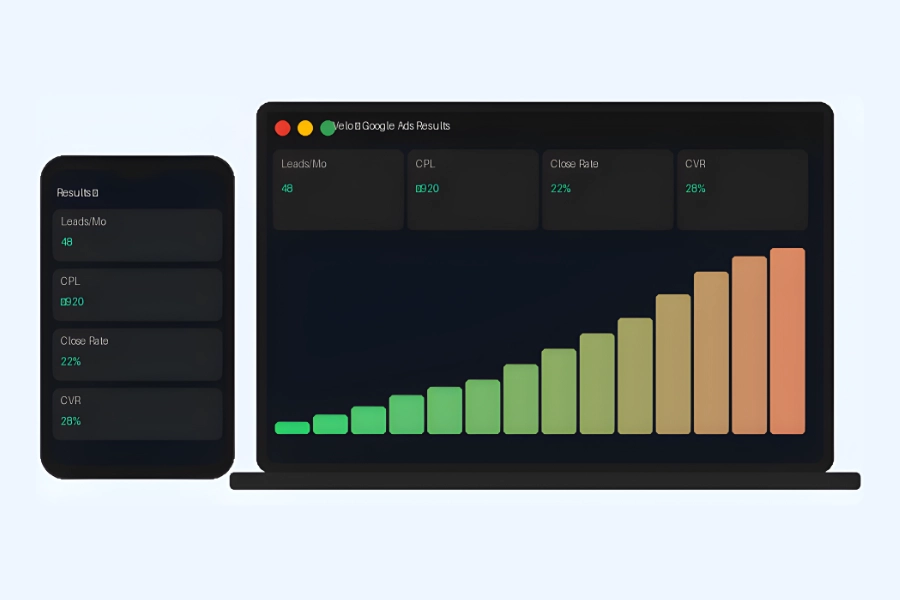
The B2B Lead Machine: 48 Qualified Leads/Month for Velo

We stopped paying for traffic from students. We started paying for pipeline from decision-makers.

48

QUALIFIED LEADS / MONTH

₹920

COST PER LEAD

4x

LEAD VOLUME GROWTH

60 Days

TIMELINE

01 · CLIENT OVERVIEW

Who We Worked With

Velo is a B2B EdTech SaaS providing LMS and school management software to K–12 schools and coaching institutes across India. Series-A stage with a 4-person sales team. They were generating MRR but leaking heavily on acquisition — each qualified lead was costing far more than it should, and most leads weren't qualified at all.

02 · PROBLEM STATEMENT

What Wasn't Working

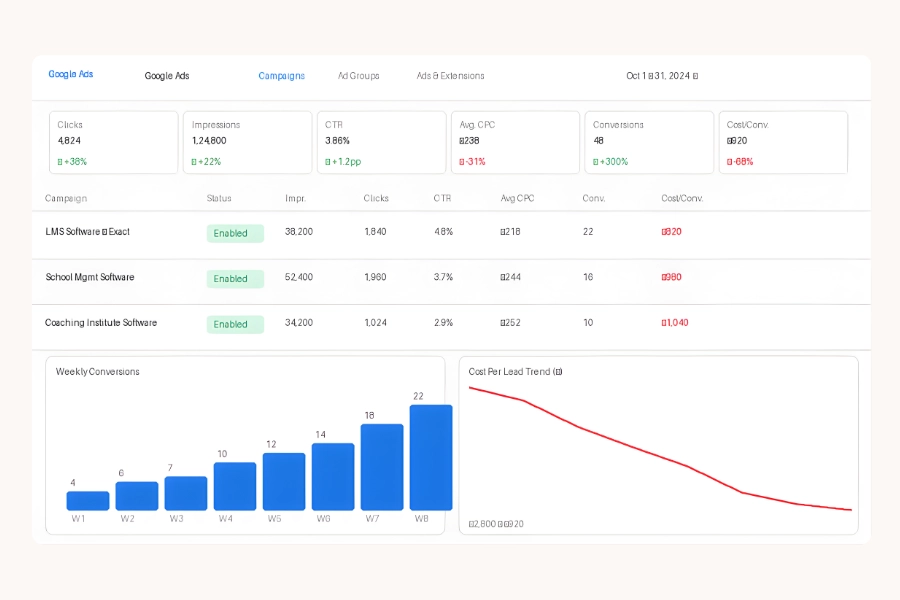
The Google Ads account was running broad-match keyword campaigns that were attracting students searching for study materials and tutoring — completely different from Velo's ICP of institute owners and school principals. Their landing page had no form above the fold, a generic 'Learn More' CTA, and a 5% conversion rate. Of 12 monthly leads, fewer than 4 would convert to demos.

03 · STRATEGY

How We Thought About It

Two parallel workstreams: account restructure and landing page rebuild. The core insight was that B2B buyers in EdTech need to see specific, outcome-led claims ('manage 500 students without a single spreadsheet') rather than feature lists. We restructured the campaigns to use exact and phrase match only, built ICP-specific landing pages per campaign, and connected CRM-qualified leads back to Google Smart Bidding as conversion signals.

In B2B Google Ads, message-to-market match is the primary lever. An institute owner looking for LMS software will click a generic ad — but they convert only when the landing page speaks exactly to their pain (manual fee collection, parent communication, attendance tracking). We built dedicated pages for each keyword theme with relevant outcomes front and centre.

04 · EXECUTION

Step-by-Step Breakdown

05 · TOOLS USED

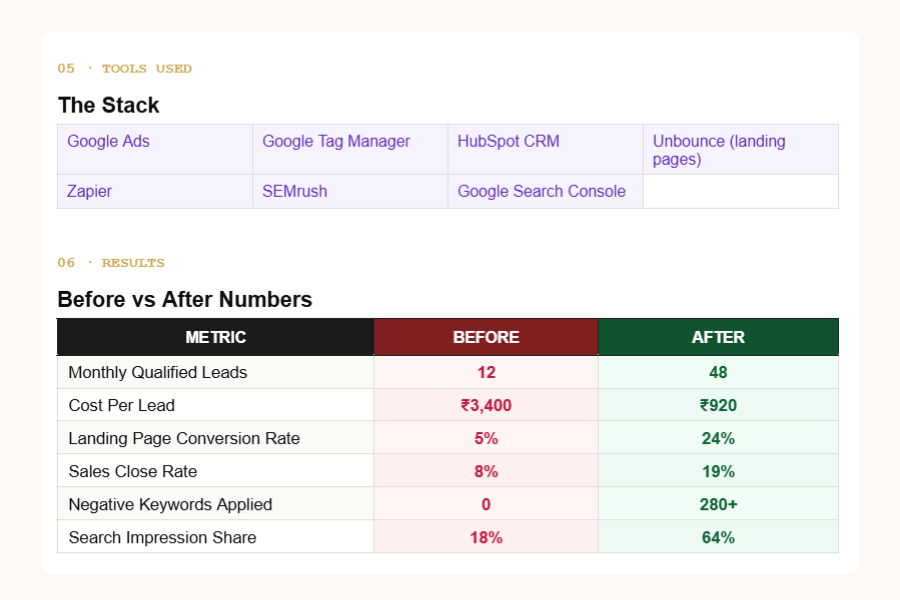
The Stack

06 · RESULTS

Before vs After Numbers

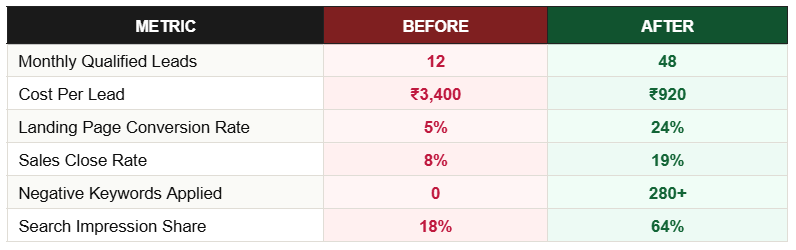
Velo Results

◈ Portfolio Design Directions (For Behance / Designer)

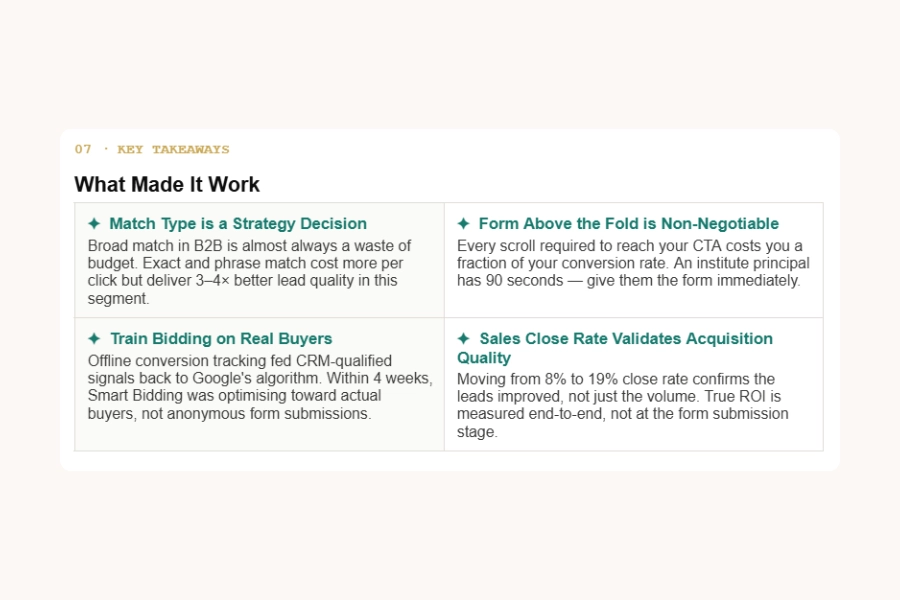
07 · KEY TAKEAWAYS

What Made It Work

Broad match in B2B is almost always a waste of budget. Exact and phrase match cost more per click but deliver 3–4× better lead quality in this segment.

Every scroll required to reach your CTA costs you a fraction of your conversion rate. An institute principal has 90 seconds — give them the form immediately.

Offline conversion tracking fed CRM-qualified signals back to Google's algorithm. Within 4 weeks, Smart Bidding was optimising toward actual buyers, not anonymous form submissions.

Moving from 8% to 19% close rate confirms the leads improved, not just the volume. True ROI is measured end-to-end, not at the form submission stage.

Screenshots

Want Results Like These?

Want us to rebuild your Google Ads account around qualified pipeline — not just traffic?

From Scroll to Sale: Rebuilding Lumis's Meta Engine

We stopped burning budget and started building a brand that actually pays for itself.

3.8x

ROAS

₹58L

PEAK REV / MONTH

−48%

COST PER ACQUISITION

11 Wks

TIMELINE

01 · CLIENT OVERVIEW

Who We Worked With

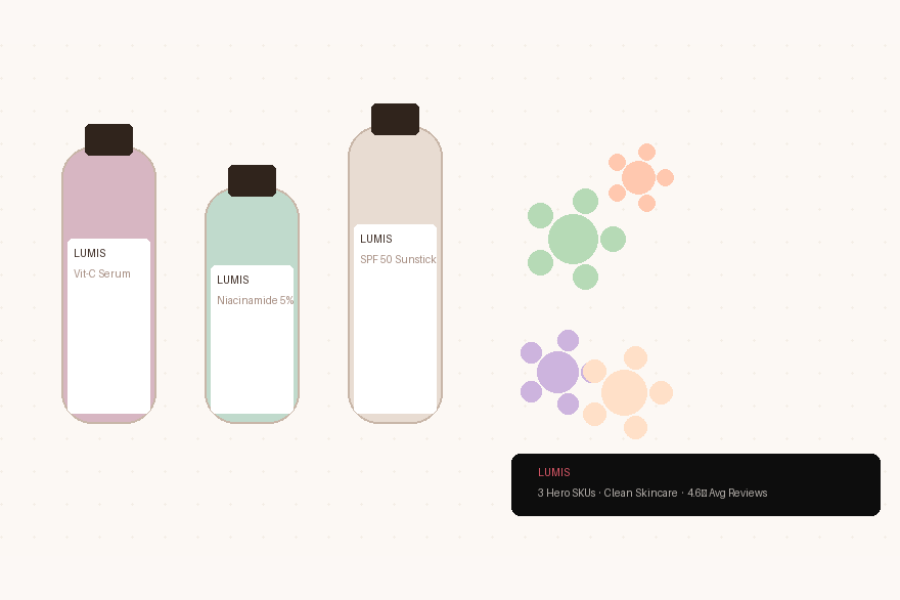
Nykora is a bootstrapped D2C skincare brand with three hero SKUs — a vitamin C serum, a niacinamide moisturiser, and an SPF sunstick — operating in the mass-premium segment. At two years old, they had strong product-market fit evidenced by 4.6-star reviews across 1,200+ orders. But they couldn't grow profitably past ₹22L/month despite steadily increasing Meta ad spend.

02 · PROBLEM STATEMENT

What Wasn't Working

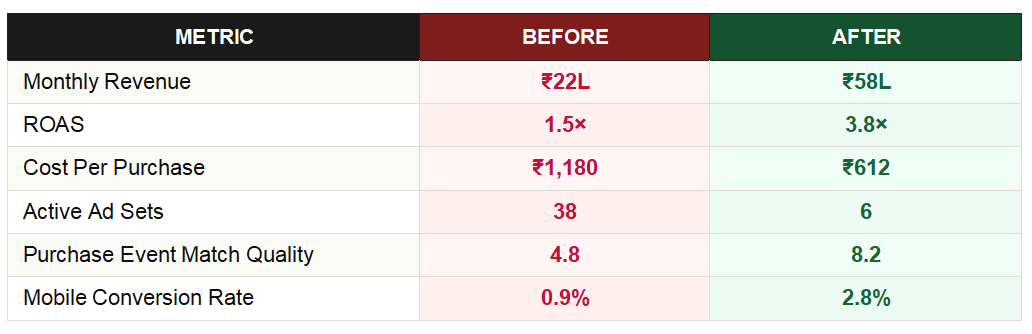
Nykora's Meta account was structurally broken before it was creatively weak. 38 ad sets ran simultaneously with no campaign organisation. Their Pixel had a purchase event misconfiguration — 40% of actual purchases went untracked. ROAS averaged 1.4–1.6×, below their breakeven of 2.2×. Every budget increase made losses worse, not better.

03 · STRATEGY

How We Thought About It

The diagnosis was structural before creative. Nykora had no working attribution, no campaign hierarchy, and no testing system. Our approach: restore tracking integrity first, then consolidate the account architecture so the algorithm receives clean signal, then build a UGC creative testing system. Scale only after all three foundations were in place.

The diagnosis was structural before creative. Nykora had no working attribution, no campaign hierarchy, and no testing system. Our approach: restore tracking integrity first, then consolidate the account architecture so the algorithm receives clean signal, then build a UGC creative testing system. Scale only after all three foundations were in place.

04 · EXECUTION

Step-by-Step Breakdown

05 · TOOLS USED

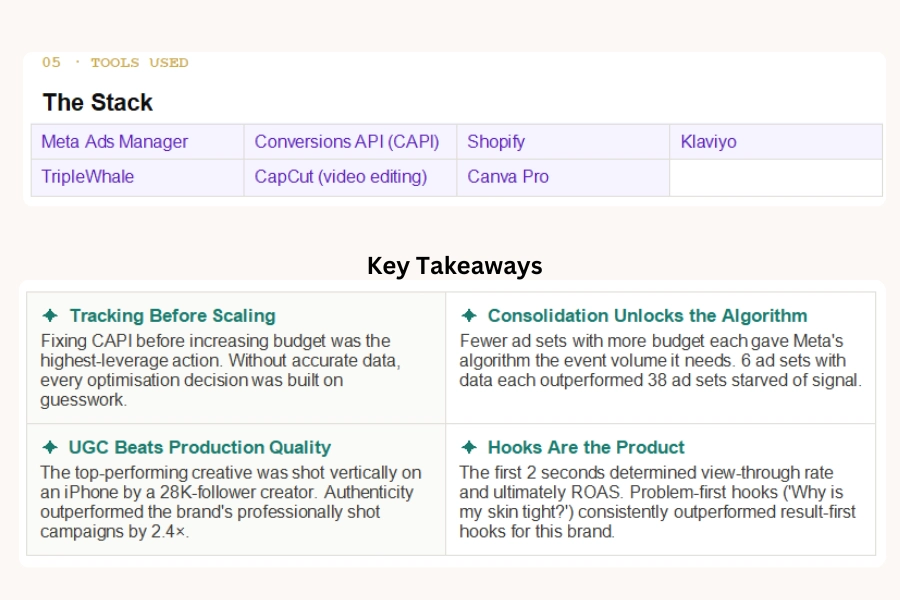
The Stack

06 · RESULTS

Before vs After Numbers

Lumis Results

◈ Portfolio Design Directions (For Behance / Designer)

07 · KEY TAKEAWAYS

What Made It Work

Fixing CAPI before increasing budget was the highest-leverage action. Without accurate data, every optimisation decision was built on guesswork.

Fewer ad sets with more budget each gave Meta's algorithm the event volume it needs. 6 ad sets with data each outperformed 38 ad sets starved of signal.

The top-performing creative was shot vertically on an iPhone by a 28K-follower creator. Authenticity outperformed the brand's professionally shot campaigns by 2.4×.

The first 2 seconds determined view-through rate and ultimately ROAS. Problem-first hooks ('Why is my skin tight?') consistently outperformed result-first hooks for this brand.

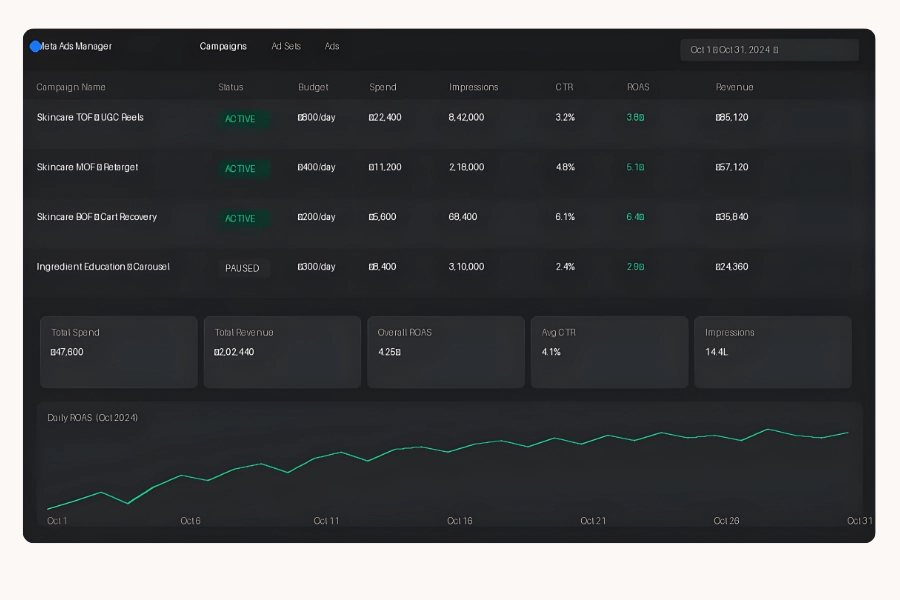
Screenshots

Want Results Like These?

Want us to audit your Meta account and rebuild it for profitable scale?