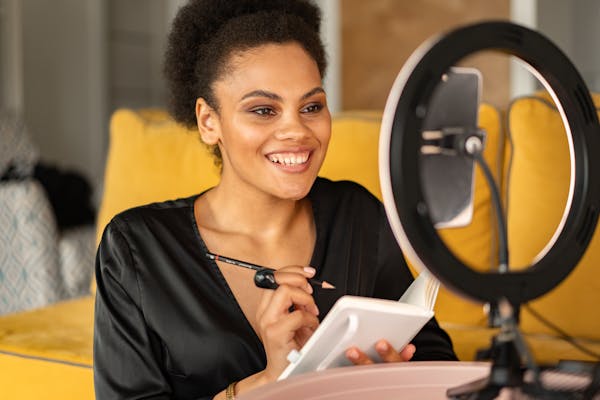

Businesses leverage the popularity of social media personalities to expand their customer base. They inquire the use of the best influencers to endorse or demonstrate their products to their followers. The persuasive power of influencers can outweigh that of regular boring ads, leading to greater credibility. Influencers’ recommendations often trigger heightened interest among their audience.

 Influencers share their finds with their social media friends. By leveraging the appeal of relatable personalities, enterprises can gracefully introduce their products to their audience. Influencers’ reach results in a noticeable effect on their audience. Through storytelling and product sharing, they effectively convince others to buy those products.

 This article will dive deeper into how influencer marketing works and how it enables companies to connect with prospective customers through authentic and trustworthy online voices!

Understanding Influencer Marketing

Amidst social media prevalence everywhere, companies desire innovative approaches to interact with customers. Companies now employ individuals possessing large social media presence to advertise and publicize their goods. Due to their extensive following and collaborations, these individuals hold expert status. This is fueled by the belief inspired by their preferred brands’ recommendations. Evidence suggests that nearly two thirds of teenagers buy items promoted by those whose posts they interact with frequently on Instagram or TikTok. This demonstrates how effectively influencer marketing can attract new clients!

How to Integrate Influencers into Your Content Strategy?

To produce a remarkable content strategy alongside influencers requires meticulous preparation. Your goal is to identify influencers capable of genuinely conveying your brand’s narrative to the proper audience!

Some things to consider include:

Finding the Right Influencer

Now, it is time to find the best influencer for your brand. But how to choose one? Here is a step by step guide to help you find the right ones for your product or brand. 

Step 1: First, be clear on what your campaign goals are – are you trying to boost sales, introduce a new product, or something else? Knowing this upfront helps guide who you choose.

Step 2: Make a list of influences in your industry who seem like a good match for your brand values. Consider things like how many followers they have and how engaged those followers are.

Step 3:  Calculate an influencer’s “engagement rate” by looking at how many likes, comments or shares their typical post gets compared to their total follower count. Higher rates show more real interest.

Step 4: While engagement is important, make sure any influencers you’re thinking of truly care about your products or services. Choose people who sincerely connect with your company’s message.

Step 5: Most importantly, pick influencers who share the same values as your brand. Trust and authenticity are key, so their followers believe in them recommending you.

By taking your time to find influencers who have the right audience, care about what you offer, and align with who you are, your campaign can create valuable partnerships audiences will truly believe in.

Case Studies of Successful Influencer Marketing

Here are some simple examples of influencer marketing campaigns that were pretty successful:

Airbnb – Airbnb partnered with adventurous travel influencers to show what it’s like living like a local in different places. This highlighted the experiences you can have instead of just focusing on rooms.

Adobe – Adobe worked with designers to demonstrate how creative people use their software in engaging videos and images. A hashtag helped their community share and talk about the content.

 Daniel Wellington – Watch brand Daniel Wellington gained interest by having fashion influencers naturally style and review their watches. Pictures of the influencers wearing the watches drove sales.

Pottery Barn – Interior designer Holly Becker included Pottery Barn furniture in her home designs for her audience. Pottery Barn then ran a giveaway which helped engage more people.

H&M – Clothing brand H&M timed their campaign with the popular Coachella music festival. Exclusive influencer content and a festival theme attracted more attention to their clothes.

These examples show how top brands have used influencers in authentic ways to showcase products, build excitement, and grow their audiences through creative and community-driven content.
influencer marketing, content strategy, digital marketing, brand promotion, social media strategy, marketing tips, online branding
Source

Conclusion

By connecting brands to influencers in a genuine way, influencer marketing opens up huge possibilities. Because the influencer genuinely believes in the company or product, a good influencer ad seems natural and authentic. This builds trust with their audience. We’ve seen case studies of how brands partnered with influences to creatively showcase their products through engaging pictures and videos. This attracts lots of new customers. Whether you’re just learning about influencer marketing or want to see how others have succeeded, the lesson is finding influencers whose audience really aligns with your brand. Make it feel like a true partnership instead of just advertising.

If done correctly, influencer marketing transforms how brands interact with people and strengthens the relationship between a company and its customers. So, connect with us and we will help you find the right influencers that will certainly suit your brand!

FAQ

What is influencer marketing and how does it work?

A: Influencer marketing is a strategy where brands collaborate with influencers to promote products or services to their followers, boosting reach and trust.

Why is a content strategy important in influencer marketing?

A: A content strategy ensures consistent, targeted messaging that aligns with brand goals, making influencer campaigns more effective and engaging.

How do you choose the right influencer for your brand?


A: Look for influencers whose niche, audience demographics, and engagement rates align with your brand values and campaign objectives.
Leave a Reply

Your email address will not be published. Required fields are marked *

Start your Project Today!

Tell us about your goals—we’ll craft a strategy that delivers real results.

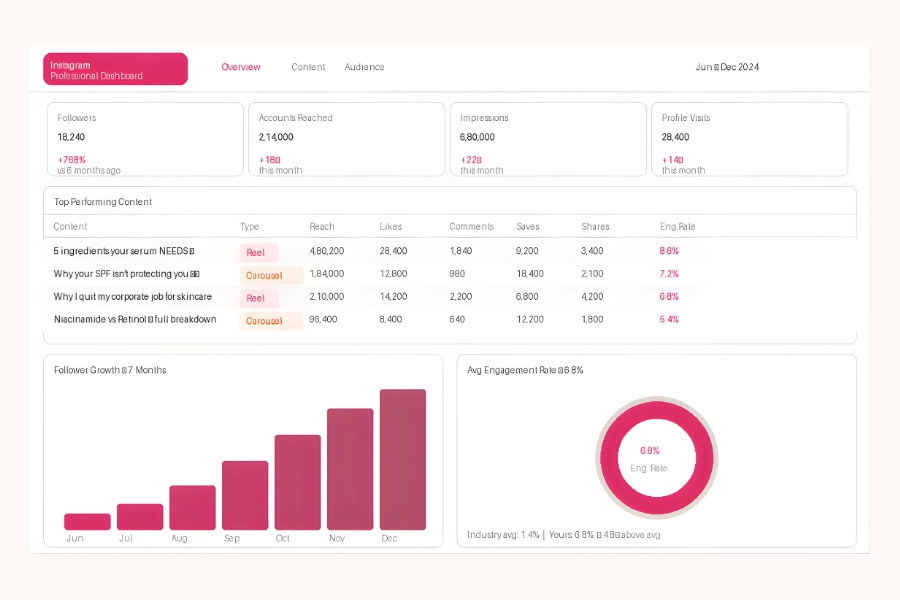
Zero to 18K: Building Petal's Community-First Instagram

From a brand nobody had discovered to a community people were recommending to their friends.

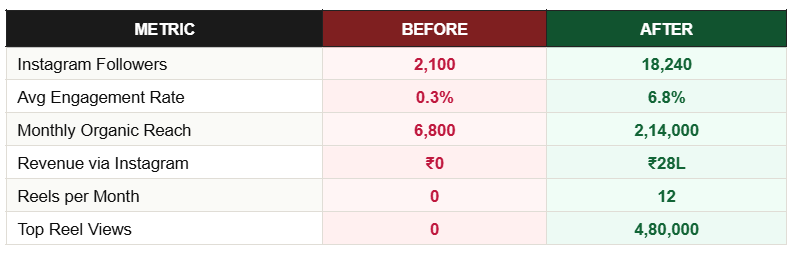
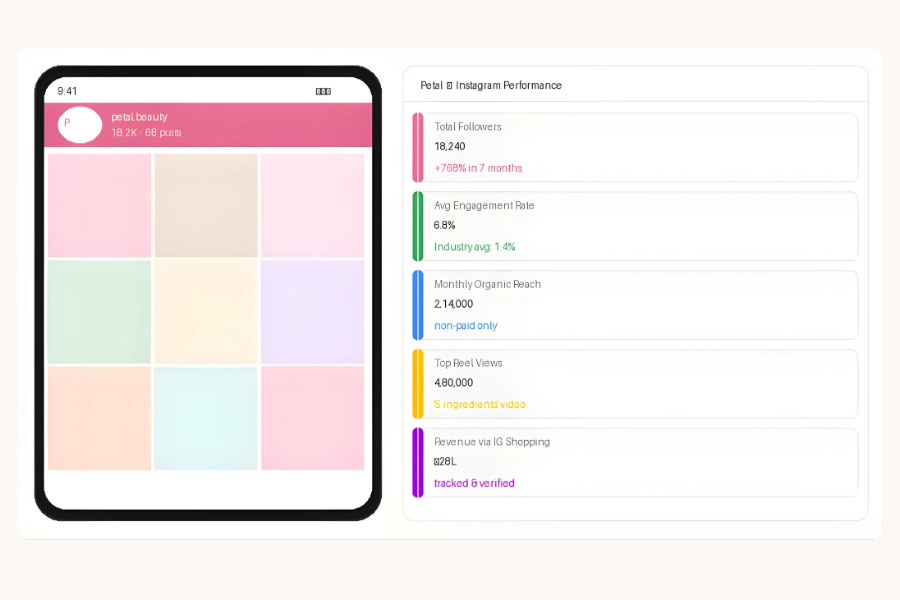
18.2K

INSTAGRAM FOLLOWERS

6.8%

AVG ENGAGEMENT RATE

₹28L

REVENUE VIA IG SHOPPING

7 Months

TIMELINE

01 · CLIENT OVERVIEW

Who We Worked With

Petal is an indie beauty startup — two founders, clean ingredients positioning, genuinely excellent products, and essentially no marketing. They had 2,100 followers when we started, near-zero reach, and a founder posting inconsistently whenever she found time. The products had earned 4.8-star reviews but nobody outside their immediate circle had heard of the brand.

02 · PROBLEM STATEMENT

What Wasn't Working

The brand had no content identity, no posting system, and no strategy connecting social media to sales. What posts did exist were flat-lay product images that looked identical to every other indie beauty brand. The founder had no time, no brief, and no creative framework. There was no link-in-bio strategy and Instagram Shopping wasn't set up.

03 · STRATEGY

How We Thought About It

We repositioned Petal from 'product showcase' to 'ingredient intelligence meets real-woman narrative.' The insight: conscious beauty buyers research before they buy. They want to understand what's in the bottle, why it works, and whether the brand is run by people who actually care. Education-first content builds that trust without ever selling. We used a 3-pillar system: Ingredient Intel, Real Skin Stories, and The Formula.

Beauty is a high-trust, high-consideration category. A follower who saves your 'Why niacinamide at 5% works' post has spent 40 seconds thinking about your product. That's 40 seconds of unprompted consideration you didn't pay for. Saves are the highest-intent action on Instagram and extend organic reach algorithmically. Teaching is the most efficient form of selling.

04 · EXECUTION

Step-by-Step Breakdown

05 · TOOLS USED

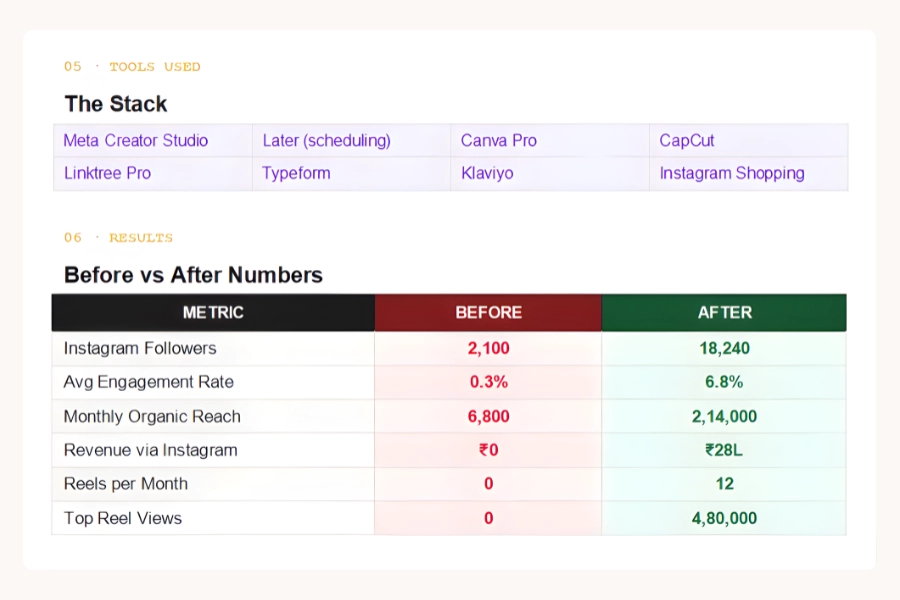
The Stack

06 · RESULTS

Before vs After Numbers

Petal Results

◈ Portfolio Design Directions (For Behance / Designer)

07 · KEY TAKEAWAYS

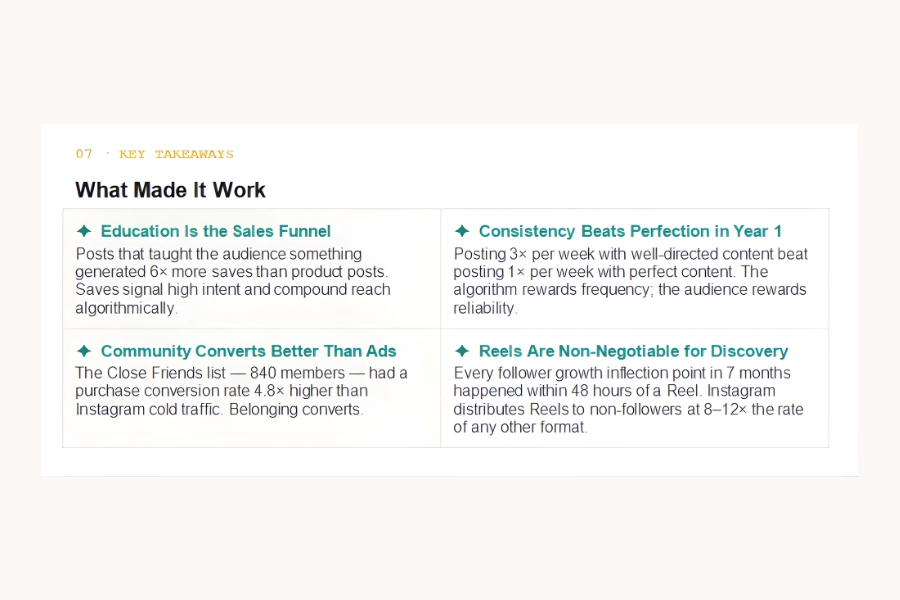
What Made It Work

Posts that taught the audience something generated 6× more saves than product posts. Saves signal high intent and compound reach algorithmically.

Posting 3× per week with well-directed content beat posting 1× per week with perfect content. The algorithm rewards frequency; the audience rewards reliability.

The Close Friends list — 840 members — had a purchase conversion rate 4.8× higher than Instagram cold traffic. Belonging converts.

Every follower growth inflection point in 7 months happened within 48 hours of a Reel. Instagram distributes Reels to non-followers at 8–12× the rate of any other format.

Screenshots

Want Results Like These?

Want to build a social media presence that earns trust, builds community, and converts?

The ₹1.8Cr Funnel Audit: How Forge Stopped Leaking Revenue

The traffic was never the problem. The funnel was the problem — and it was haemorrhaging at every single stage.

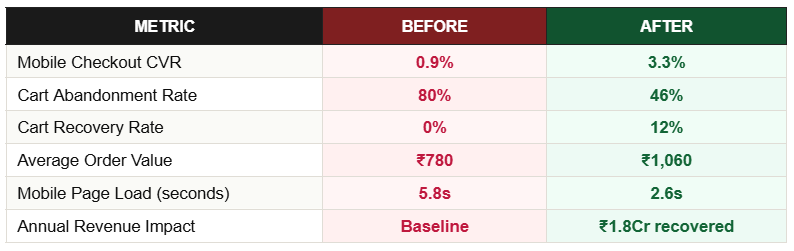
₹1.8Cr

ANNUAL REVENUE RECOVERED

+280%

CHECKOUT CONVERSION

−42%

CART ABANDONMENT

6 Weeks

TIMELINE

01 · CLIENT OVERVIEW

Who We Worked With

Forge is a funded D2C nutrition brand — protein supplements, health snacks, electrolyte drinks — spending ₹5Cr/month on paid acquisition. Strong brand awareness, high repeat purchase rate, but conversion benchmarks consistently 35–40% below category averages. The CEO knew there was leakage — just not where.

02 · PROBLEM STATEMENT

What Wasn't Working

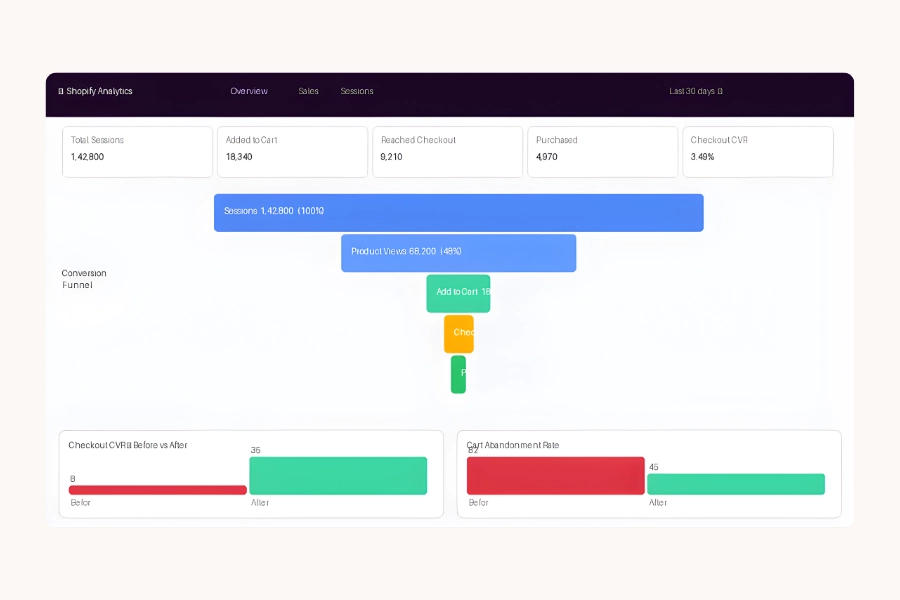
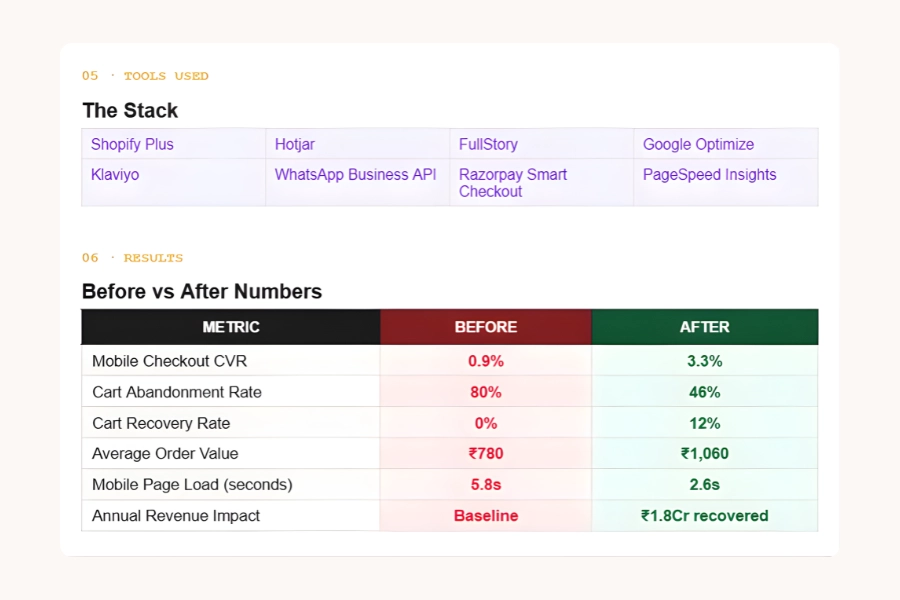
A ₹5Cr/month traffic budget was feeding a funnel that converted at 0.9% on mobile — against an industry average of 2.4%. The mobile checkout had 11 form fields. There was no cart recovery sequence. Product pages were beautiful but led with ingredient lists rather than outcomes. The brand had never run a structured CRO audit.

03 · STRATEGY

How We Thought About It

We ran a complete CRO audit before touching a single element: heatmaps to find where attention was lost, session recordings to find where users hesitated, and funnel analytics to quantify drop-off at each stage. Only after building the full picture did we prioritise fixes by impact-to-effort ratio. High-impact, low-effort changes first. A/B tests on every significant change before full rollout.

At ₹5Cr monthly ad spend, even a 0.5% improvement in checkout conversion rate generates significant incremental monthly revenue — with no additional acquisition cost. Funnel optimisation at scale has the highest ROI of any marketing activity. The traffic is already paid for.

04 · EXECUTION

Step-by-Step Breakdown

05 · TOOLS USED

The Stack

06 · RESULTS

Before vs After Numbers

Forge Results

◈ Portfolio Design Directions (For Behance / Designer)

07 · KEY TAKEAWAYS

What Made It Work

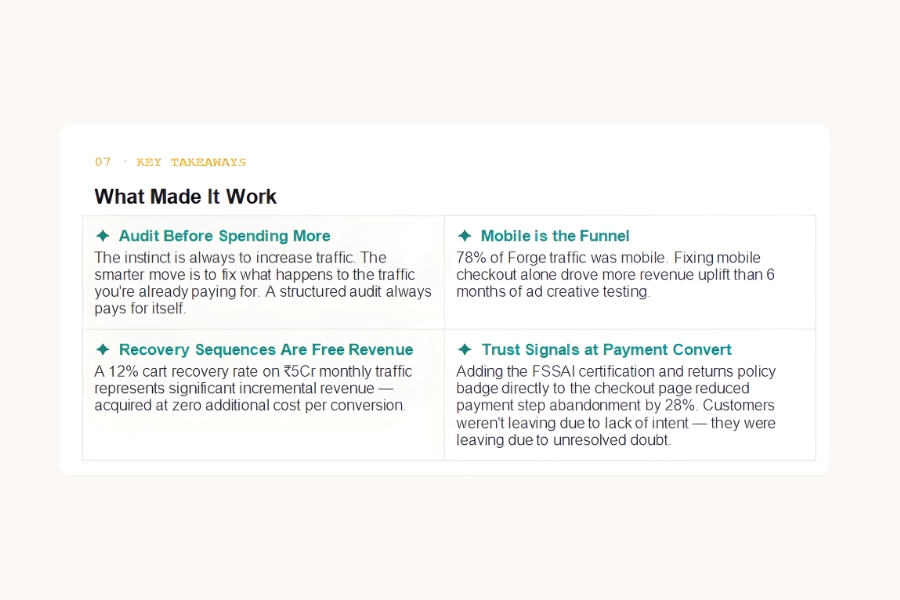
The instinct is always to increase traffic. The smarter move is to fix what happens to the traffic you're already paying for. A structured audit always pays for itself.

78% of Forge traffic was mobile. Fixing mobile checkout alone drove more revenue uplift than 6 months of ad creative testing.

A 12% cart recovery rate on ₹5Cr monthly traffic represents significant incremental revenue — acquired at zero additional cost per conversion.

Adding the FSSAI certification and returns policy badge directly to the checkout page reduced payment step abandonment by 28%. Customers weren't leaving due to lack of intent — they were leaving due to unresolved doubt.

Screenshots

Want Results Like These?

Want us to audit your funnel and find the revenue that's already in your traffic?

The B2B Lead Machine: 48 Qualified Leads/Month for Velo

We stopped paying for traffic from students. We started paying for pipeline from decision-makers.

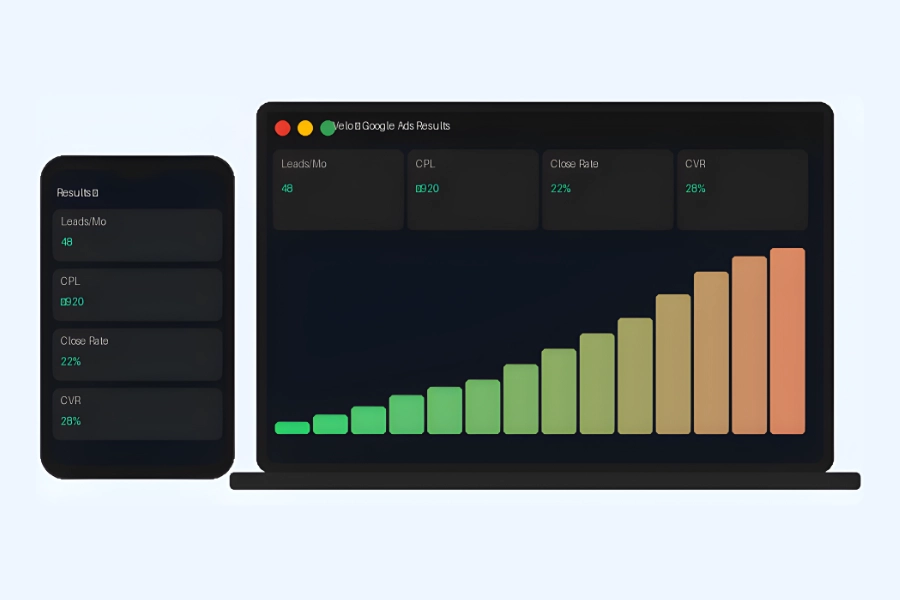
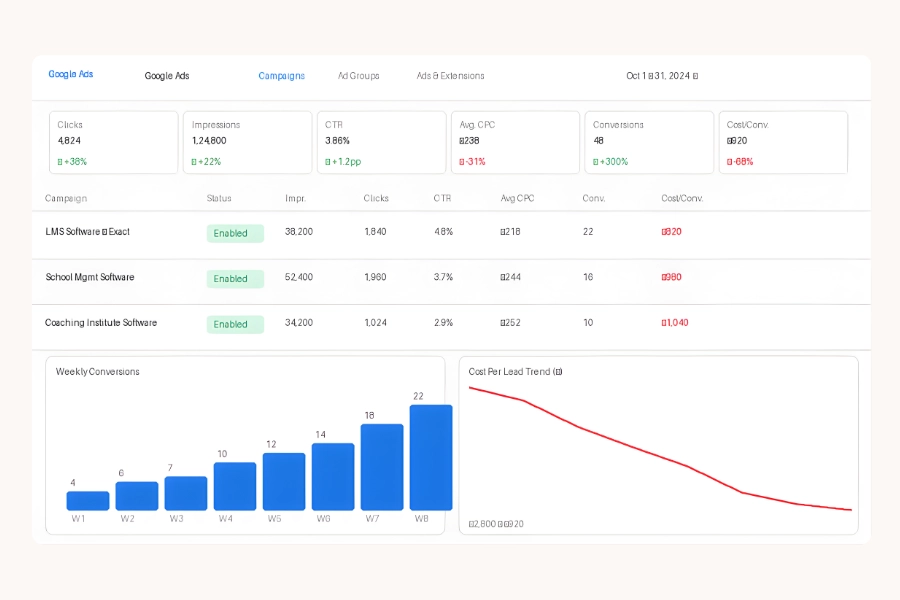
48

QUALIFIED LEADS / MONTH

₹920

COST PER LEAD

4x

LEAD VOLUME GROWTH

60 Days

TIMELINE

01 · CLIENT OVERVIEW

Who We Worked With

Velo is a B2B EdTech SaaS providing LMS and school management software to K–12 schools and coaching institutes across India. Series-A stage with a 4-person sales team. They were generating MRR but leaking heavily on acquisition — each qualified lead was costing far more than it should, and most leads weren't qualified at all.

02 · PROBLEM STATEMENT

What Wasn't Working

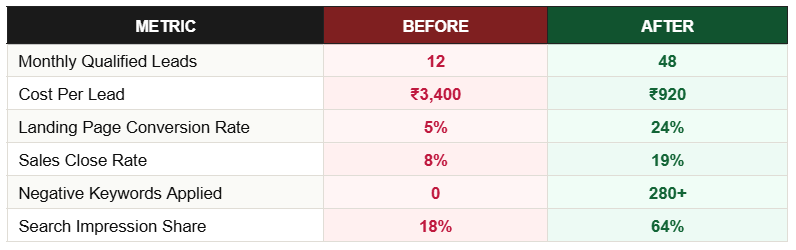
The Google Ads account was running broad-match keyword campaigns that were attracting students searching for study materials and tutoring — completely different from Velo's ICP of institute owners and school principals. Their landing page had no form above the fold, a generic 'Learn More' CTA, and a 5% conversion rate. Of 12 monthly leads, fewer than 4 would convert to demos.

03 · STRATEGY

How We Thought About It

Two parallel workstreams: account restructure and landing page rebuild. The core insight was that B2B buyers in EdTech need to see specific, outcome-led claims ('manage 500 students without a single spreadsheet') rather than feature lists. We restructured the campaigns to use exact and phrase match only, built ICP-specific landing pages per campaign, and connected CRM-qualified leads back to Google Smart Bidding as conversion signals.

In B2B Google Ads, message-to-market match is the primary lever. An institute owner looking for LMS software will click a generic ad — but they convert only when the landing page speaks exactly to their pain (manual fee collection, parent communication, attendance tracking). We built dedicated pages for each keyword theme with relevant outcomes front and centre.

04 · EXECUTION

Step-by-Step Breakdown

05 · TOOLS USED

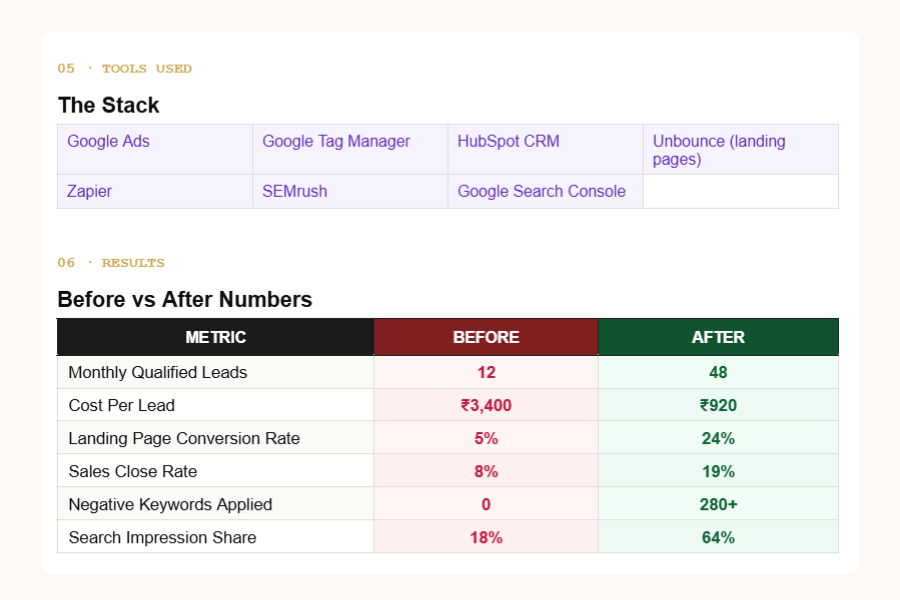
The Stack

06 · RESULTS

Before vs After Numbers

Velo Results

◈ Portfolio Design Directions (For Behance / Designer)

07 · KEY TAKEAWAYS

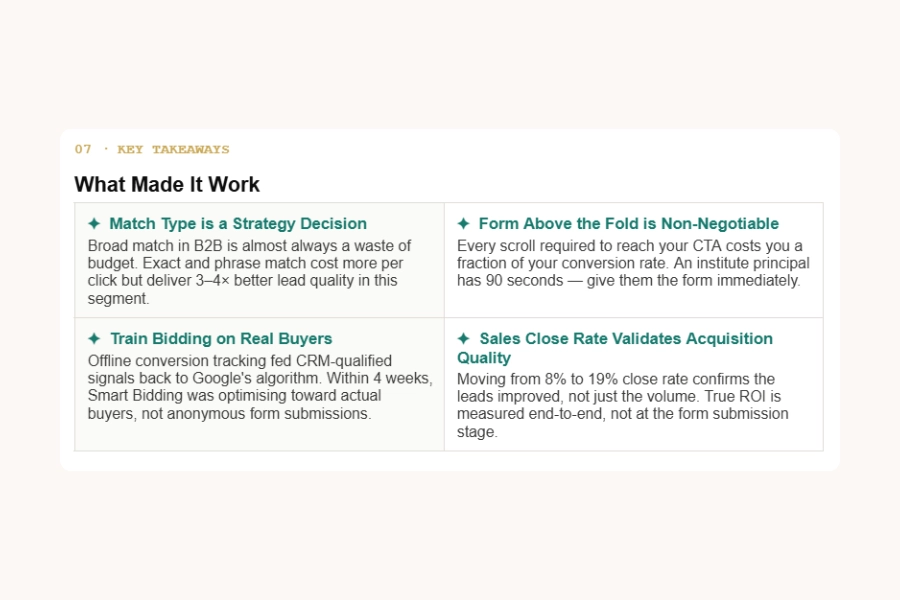
What Made It Work

Broad match in B2B is almost always a waste of budget. Exact and phrase match cost more per click but deliver 3–4× better lead quality in this segment.

Every scroll required to reach your CTA costs you a fraction of your conversion rate. An institute principal has 90 seconds — give them the form immediately.

Offline conversion tracking fed CRM-qualified signals back to Google's algorithm. Within 4 weeks, Smart Bidding was optimising toward actual buyers, not anonymous form submissions.

Moving from 8% to 19% close rate confirms the leads improved, not just the volume. True ROI is measured end-to-end, not at the form submission stage.

Screenshots

Want Results Like These?

Want us to rebuild your Google Ads account around qualified pipeline — not just traffic?

From Scroll to Sale: Rebuilding Lumis's Meta Engine

We stopped burning budget and started building a brand that actually pays for itself.

3.8x

ROAS

₹58L

PEAK REV / MONTH

−48%

COST PER ACQUISITION

11 Wks

TIMELINE

01 · CLIENT OVERVIEW

Who We Worked With

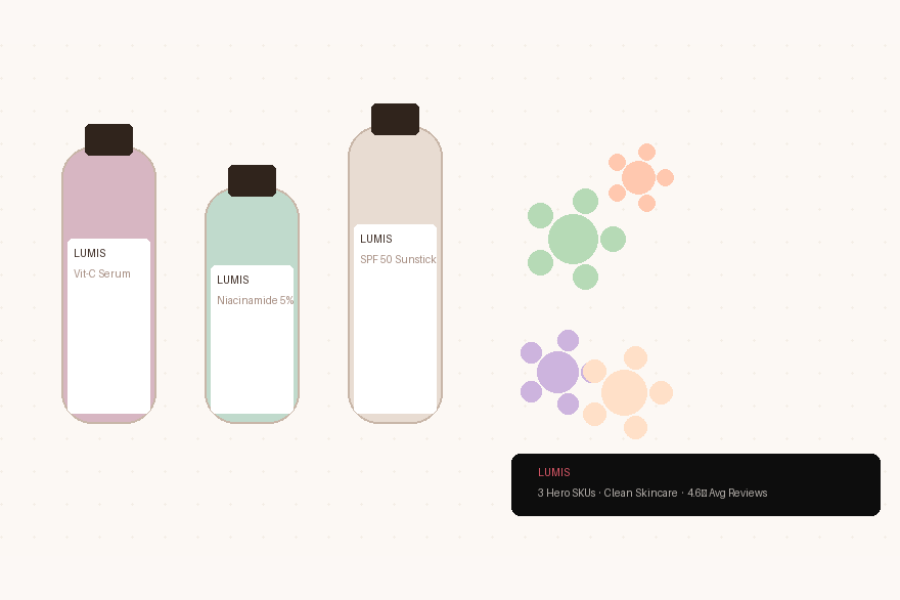
Nykora is a bootstrapped D2C skincare brand with three hero SKUs — a vitamin C serum, a niacinamide moisturiser, and an SPF sunstick — operating in the mass-premium segment. At two years old, they had strong product-market fit evidenced by 4.6-star reviews across 1,200+ orders. But they couldn't grow profitably past ₹22L/month despite steadily increasing Meta ad spend.

02 · PROBLEM STATEMENT

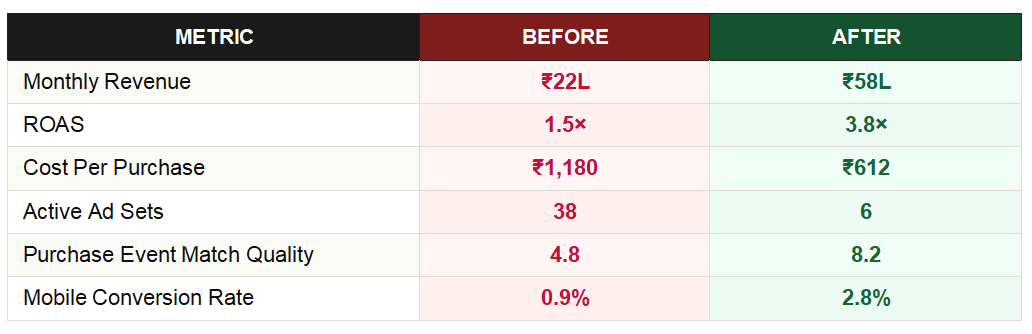
What Wasn't Working

Nykora's Meta account was structurally broken before it was creatively weak. 38 ad sets ran simultaneously with no campaign organisation. Their Pixel had a purchase event misconfiguration — 40% of actual purchases went untracked. ROAS averaged 1.4–1.6×, below their breakeven of 2.2×. Every budget increase made losses worse, not better.

03 · STRATEGY

How We Thought About It

The diagnosis was structural before creative. Nykora had no working attribution, no campaign hierarchy, and no testing system. Our approach: restore tracking integrity first, then consolidate the account architecture so the algorithm receives clean signal, then build a UGC creative testing system. Scale only after all three foundations were in place.

The diagnosis was structural before creative. Nykora had no working attribution, no campaign hierarchy, and no testing system. Our approach: restore tracking integrity first, then consolidate the account architecture so the algorithm receives clean signal, then build a UGC creative testing system. Scale only after all three foundations were in place.

04 · EXECUTION

Step-by-Step Breakdown

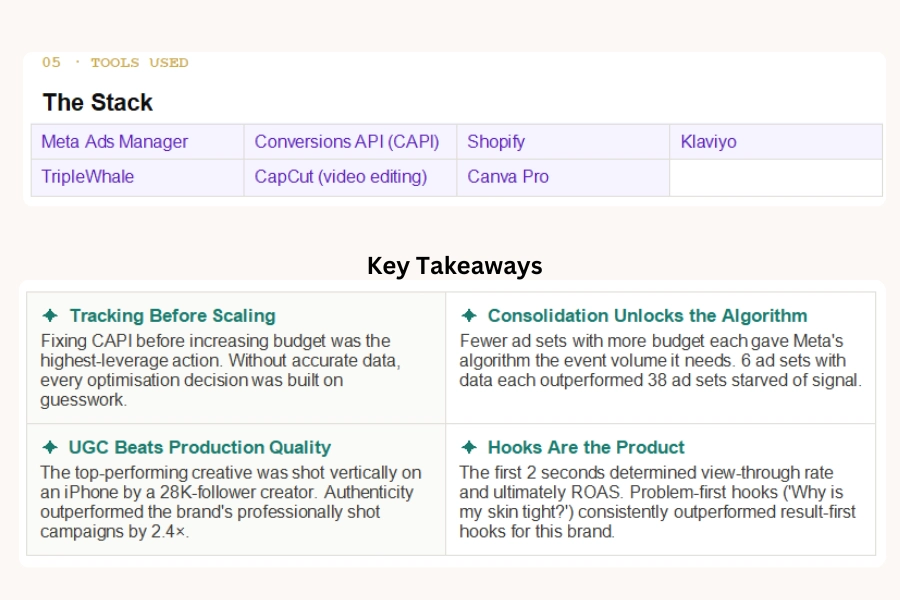
05 · TOOLS USED

The Stack

06 · RESULTS

Before vs After Numbers

Lumis Results

◈ Portfolio Design Directions (For Behance / Designer)

07 · KEY TAKEAWAYS

What Made It Work

Fixing CAPI before increasing budget was the highest-leverage action. Without accurate data, every optimisation decision was built on guesswork.

Fewer ad sets with more budget each gave Meta's algorithm the event volume it needs. 6 ad sets with data each outperformed 38 ad sets starved of signal.

The top-performing creative was shot vertically on an iPhone by a 28K-follower creator. Authenticity outperformed the brand's professionally shot campaigns by 2.4×.

The first 2 seconds determined view-through rate and ultimately ROAS. Problem-first hooks ('Why is my skin tight?') consistently outperformed result-first hooks for this brand.

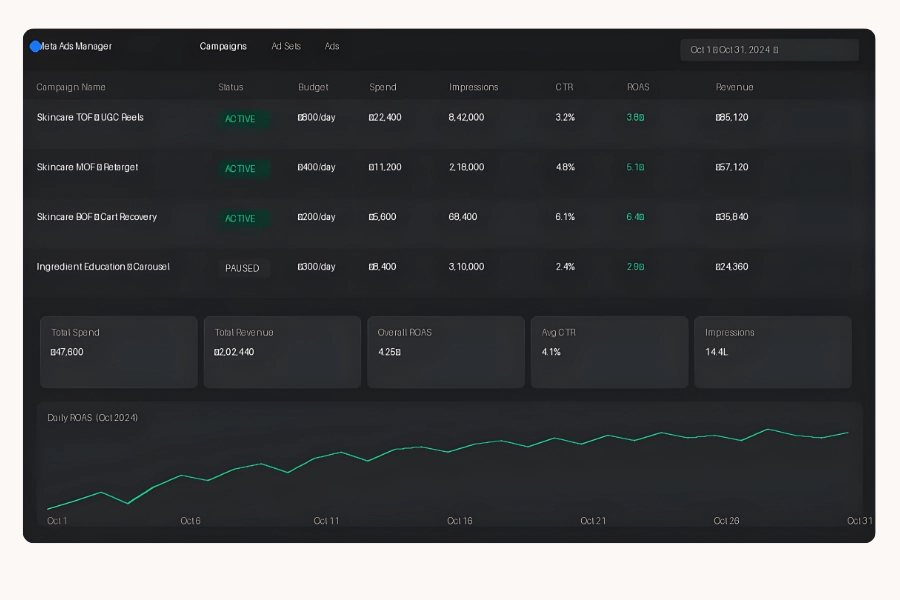
Screenshots

Want Results Like These?

Want us to audit your Meta account and rebuild it for profitable scale?